

Most guides on anchor text distribution hand you a percentage chart and tell you to match it. That advice is tidy, but it doesn’t hold up in real audits.
A healthy profile depends on your brand, your industry, and how your links were earned. Google has never published an ideal ratio. What it does say is that anchor text should be descriptive, relevant, and natural.
This guide shows you how to manage anchor text distribution as a pattern to diagnose, not a number to hit. You’ll get a step-by-step audit process, a worked example, and a plan for fixing a profile that has drifted too far toward exact-match keywords.
What Is Anchor Text Distribution?
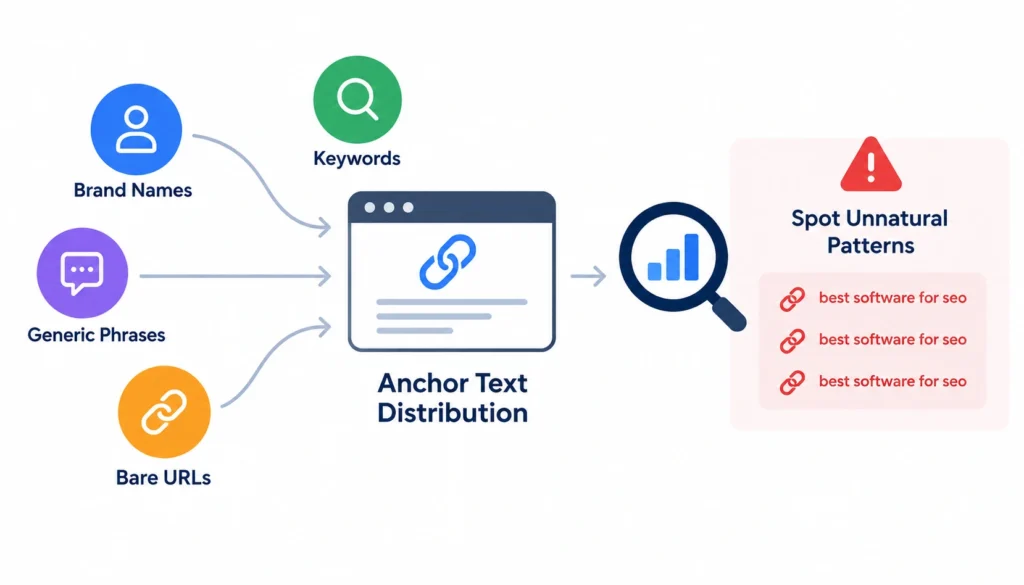
Anchor text distribution is the mix of clickable words other sites use when they link to yours. It shows how often each anchor type appears, such as brand names, keywords, generic phrases, and bare URLs. SEOs review it to spot unnatural patterns, like one commercial phrase repeated across many links.
What is anchor text?
Anchor text is the visible, clickable part of a link. In <a href=”https://example.com”>backlink audit guide</a>, the anchor text is “backlink audit guide.” Search engines use it, along with the surrounding content, to understand what the linked page is about. (Wikipedia has a short overview of anchor text.)
What does distribution mean?
Take every link pointing to your site, sort the anchors into groups, and count each group. That breakdown is your distribution. You can run it for the whole domain or for a single page, and the page-level view often tells you more.
Why it matters for SEO
Anchors give context. A link that says “learn more” tells a search engine very little. A link that says “how to audit backlinks” tells it a lot.
The problem starts when the same commercial phrase shows up again and again across many sites. Real editors rarely link that way, so the pattern looks engineered. Google’s spam policies list link spam, including large-scale guest posting or article campaigns that use keyword-rich anchors.
Anchor text distribution vs. backlink distribution
These are related but different. Backlink distribution asks where your links come from and where they point. Anchor text distribution asks what words those links use. You need both views, because ten links from ten relevant sites with the same exact-match anchor can look worse than ten varied links from one site.
What Are the Different Types of Anchor Text?
There are seven types worth tracking:
- Branded
- Exact match
- Partial match
- Generic
- Naked URL
- Descriptive or long-tail
- Image (alt text)
Here is how they compare.
| Type | Example | Main job | Risk level |
| Branded | Acme Analytics | Brand recognition | Low |
| Exact match | link building software | Keyword relevance | Higher if forced or repeated |
| Partial match | software for building links | Context plus keyword | Moderate |
| Generic | learn more, this site | Reader convenience | Usually low |
| Naked URL | acme.com | Plain citation | Low |
| Descriptive | a guide to backlink audits | Relevance and clarity | Usually low |
| Image | alt text of a linked image | Context for image links | Low |
Branded anchors
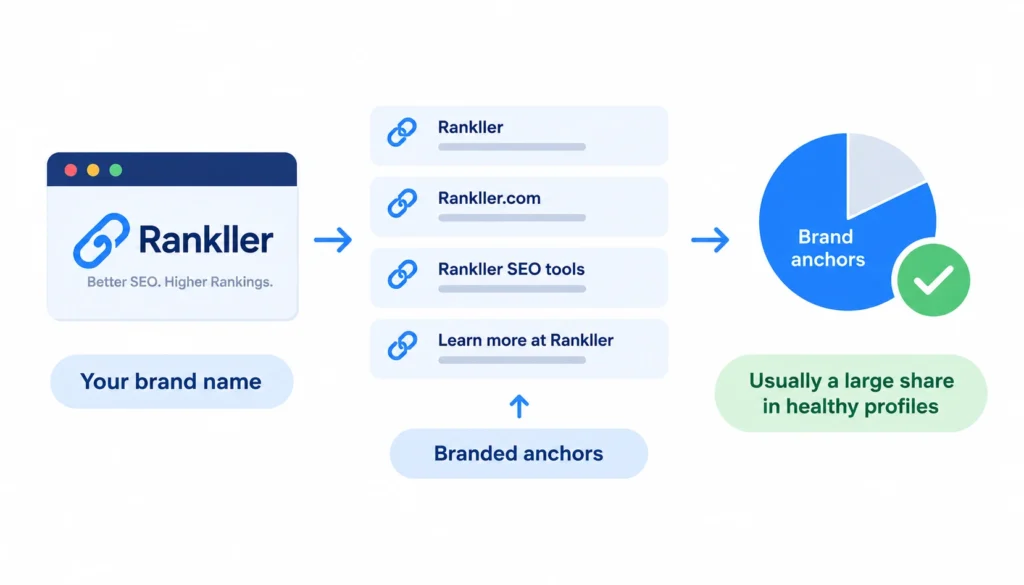
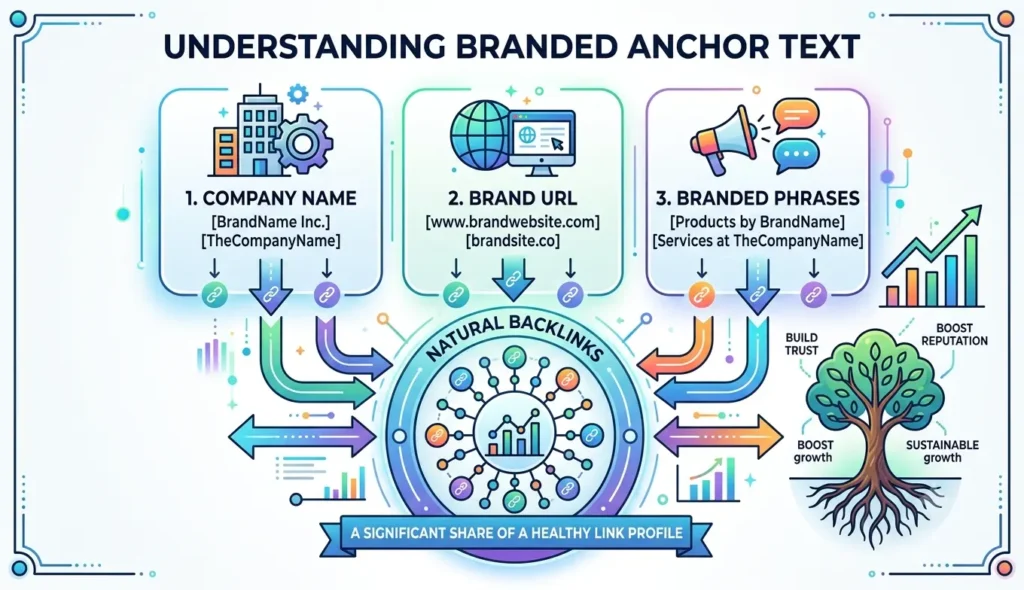
These use your company or product name. They show up naturally when people cite you as a source, which is why they usually make up a large share of healthy profiles.
Exact-match anchors
The anchor is the exact keyword you want to rank for. One or two from relevant editorial sources is normal. A pile of them from unrelated sites is a warning sign.
Partial-match anchors
These include your keyword plus other words, like “our guide to anchor text audits.” They read more naturally than exact match and still carry context.
Generic anchors
Phrases like “click here,” “read more,” or “this article.” Editors write these all the time. They add little context but they also add little risk.
Naked URL anchors
The link text is the address itself. Writers use these when they cite a source without dressing it up.
Descriptive and long-tail anchors
These are full phrases that describe the page, such as “a step-by-step way to check your backlink anchors.” They tend to appear when a writer links mid-sentence and describes what the reader will find.
Image anchors
When an image is the link, Google treats its alt text as the anchor. Google’s link best practices cover this. If you link images internally, write alt text that describes the destination.
Is There an Ideal Anchor Text Distribution?
No. Google has not published a target percentage for any anchor type. Third-party guides give ratios, but those are their own benchmarks, and they often disagree with each other. Use percentages to spot unusual concentrations, then investigate the cause.
Why fixed ratios mislead
A ratio tells you what a profile looks like, not why it looks that way. Two sites can have identical percentages and completely different risk. One earned its links through press coverage. The other bought them.
Ratios also hide scale. Ten exact-match links in a profile of 40 is 25%. Ten in a profile of 4,000 is 0.25%. Same count, very different picture.
What percentage benchmarks can and can’t tell you
They can tell you when something is out of line with typical profiles. In audits, branded, URL, and generic anchors often make up most of a site’s links, and exact match tends to be a small slice. That’s an observation, not a rule.
They can’t tell you whether your links are good, whether you’ll be penalized, or whether changing a number will move rankings. No ratio guarantees a ranking, and no specific percentage automatically triggers a penalty.
Factors that change a natural distribution
Website type. A brand-led business gets cited by name. A niche blog with no brand recognition may see more descriptive anchors.
Industry. Some industries have obvious product terms that writers use as anchors naturally. Others don’t.
Brand strength. The better known you are, the more branded and naked-URL anchors you’ll attract.
Page type. Homepages usually collect brand and URL links. Deep pages collect topic-specific ones.
Link acquisition method. Editorial mentions, outreach, guest posts, and digital PR each produce different anchor patterns. You control the pattern most when you request links directly.
Website age and history. An older site has years of accumulated links, and past campaigns may still shape its profile.
How to Manage Anchor Text Distribution Step by Step
Here is the process in one line: export, clean, classify, calculate, segment, investigate, compare, adjust, monitor. Each step is below.
Step 1: Export your backlink data
Pull your links from more than one source. Ahrefs, Semrush, Majestic, and SEO SpyGlass all export anchor data. Google Search Console has a Links report that shows top linking text, and it’s free, though it’s a sample rather than a full list. Combining sources gives you better coverage.
Step 2: Clean and normalize the anchors
Raw exports are messy. Merge these before you count anything:
- Capitalization differences (“Acme” and “acme”)
- Singular and plural versions
- Brand misspellings and variations
- URL versions (with and without https or www)
- Near-identical phrases
Also remove obvious junk, like scraped or duplicate rows.
Step 3: Classify every anchor
Sort each one into a category: branded, exact, partial, generic, URL, descriptive, image, or other. For large exports, you can filter by your brand name and target keywords first, then handle the rest by hand. Expect to spend real time on borderline cases.
Step 4: Calculate the distribution
Use this formula:
Anchor type % = links using that type ÷ total links analyzed × 100
Decide up front whether you’re counting links or referring domains. Counting domains is often more honest, because one site can link to you 300 times from its footer and skew everything.
Step 5: Analyze by destination URL
This step separates a real audit from a quick check. Run the same calculation for each important page. A domain can look balanced while one service page has 60% of its links using the same commercial phrase.
Step 6: Look for concentration
Flag any of these:
- One anchor dominating a page or the whole profile
- The same commercial wording across many unrelated domains
- Anchors that don’t fit the sentence around them
- Links from pages with no topical connection to yours
- A sudden jump after a campaign
Step 7: Compare against relevant competitors
Look at who ranks for your target terms and check their anchor mix, referring domains, and linked pages. Use this to understand the norm in your niche, not to copy anyone. Competitors may have stronger brands, longer histories, or different acquisition methods.
Step 8: Adjust future link acquisition
Stop asking for the same anchor. When you do outreach, let the editor choose the wording, or suggest linking to a page by its title. Aim for relevance first, and accept that the anchor will vary.
Step 9: Monitor over time
Check monthly for new links and quarterly for a full audit. Review new links separately from your historical profile. That way a shift shows up quickly instead of being buried in years of data.
How to Tell if Your Anchor Text Profile Is Over-Optimized
An over-optimized profile usually shows a repeated pattern that real editors wouldn’t produce on their own. The signals below show up together more often than alone.
Signs of over-optimization
- One keyword phrase dominates a page’s links
- Exact-match anchors are far more common than branded ones
- Many domains use identical commercial wording
- Anchors read awkwardly in their sentences
- Links come from off-topic or low-quality pages
- Anchors spike right after an outreach or guest post push
Why exact-match concentration can be a problem
Google doesn’t publish a threshold. What it does publish is a list of link schemes it treats as spam, including links built mainly to influence rankings. A heavy exact-match pattern can suggest that’s what happened, even if you didn’t intend it. Some SEO communities discuss real-world cases, and r/SEO on Reddit is a useful place to see how other practitioners read these patterns.
Since 2016, Penguin has been part of Google’s core ranking system and runs continuously. (Wikipedia covers the history of Google Penguin.) Google has also said its systems are built to ignore many spammy links rather than punish for them, so a messy profile doesn’t always mean a penalty. Treat that as a reason to investigate calmly, not to panic.
Natural variation vs. artificial variation
More variety is not automatically better. If you take one keyword and generate 30 synonyms to rotate through, you’ve created a new pattern, just a more complicated one. Real variation comes from real editors linking for their own reasons. Your job is to earn links from relevant places and let the wording vary.
How to Fix an Over-Optimized Anchor Text Profile
Fixing it is mostly about changing what you do next, not scrubbing what already exists. Work through these in order.
Audit before you act
List the concentrated anchors, the pages they point to, and the domains they come from. Don’t touch anything until you know what you’re looking at.
Separate legitimate links from manipulative ones
A keyword-heavy anchor on a real editorial article from a relevant site is usually fine. The same anchor on a paid directory or a network of thin blogs is a different story. Judge each source on its own.
Stop requesting repetitive commercial anchors
If you or a vendor keeps asking for the same phrase, end that today. It’s the fastest way to stop making the problem bigger.
Earn more natural links
Publish things people cite by name: original research, tools, or well-sourced guides. These attract branded and descriptive anchors without any requests. Digital PR does the same when it earns real coverage.
Improve internal linking
You control internal anchors, so use them well. Link with descriptive, natural wording that fits the sentence. This won’t erase external patterns, but it gives search engines clear context about your pages.
Contact publishers when it makes sense
If a legitimate site linked to you with an odd anchor, a polite request to adjust it can work, especially if you have a relationship. Don’t expect high success rates, and don’t push.
When to consider Google’s disavow tool
Google’s disavow documentation says most sites don’t need it. It’s meant for cases where you have a large number of spammy or artificial links and they’ve caused, or are likely to cause, a manual action. Don’t disavow legitimate links just because the anchor text is imperfect.
Internal vs. External Anchor Text Distribution
Internal and external anchors follow different rules because you control one and mostly don’t control the other.
| Factor | Internal links | External backlinks |
| Control | High | Low |
| Who picks the anchor | You | Usually the linking site |
| Main role | Site structure and context | Outside relevance and context |
| Exact-match use | Fine when it reads naturally | Needs more care |
| Monitoring | Easy | Harder |
Google’s guidance for both is the same: use anchor text that is descriptive, reasonably short, and relevant. The difference is that you can fix internal anchors in an afternoon, while external ones depend on other people.
How Anchor Text Distribution Changes by Page Type
Different pages attract different links, so judge each type on its own terms.
Homepage. Expect mostly brand names and naked URLs. That’s what happens when people cite a company.
Blog content. These pages pick up descriptive anchors, often the article’s topic or title.
Product pages. Anchors often include the product name. Watch for repeated commercial phrases if you run outreach for these pages.
Service pages. These are commonly the target of keyword-focused campaigns, so check them first for concentration.
Category pages. Ecommerce categories tend to get few external links. If one has many keyword-heavy anchors, look closely.
Resource pages. Guides and tools earn natural, descriptive anchors when they’re good.
Local landing pages. Anchors often include a city or service area. That’s normal for local businesses, but repetition across many sites is still a pattern to watch.
How to Analyze Competitors’ Anchor Text Distribution
Competitor analysis tells you what’s typical in your space. It shouldn’t set your targets.
What to compare
- Top anchor phrases
- Share of branded vs. commercial anchors
- Number of referring domains
- Which pages get the links
- Recent new and lost links
Don’t copy a competitor’s ratio
A competitor might rank well with a heavily commercial profile because they have years of strong links behind it. You can’t copy that history. Your brand recognition, link sources, and site age are different, so their numbers won’t fit you.
Anchor Text Distribution Example
This is a hypothetical profile, built to show how to read the data. It’s not a benchmark.
Before the audit
A site has 200 backlinks analyzed at the domain level.
| Anchor category | Links | % |
| Branded | 80 | 40% |
| Partial match | 45 | 22.5% |
| Generic | 35 | 17.5% |
| URL | 25 | 12.5% |
| Exact match | 15 | 7.5% |
At first glance this looks fine. Exact match is under 8%, and branded links lead.
What the data tells us
Now segment by page. Say 12 of those 15 exact-match links point to one service page that has only 30 links in total. On that page, exact match is 40%. The domain view hid the problem completely.
Then check the sources. If those 12 links come from relevant industry blogs and the anchors fit the sentences, you may have nothing to fix. If they come from a batch of guest posts published in the same quarter, you have a pattern to address. Numbers raise the question. Link quality, relevance, and acquisition history answer it.
Turning the audit into an action plan
- Pause any outreach that requests that service-page anchor.
- Review the 12 sources and mark which are legitimate.
- Plan content that earns branded and descriptive links to that page.
- Add descriptive internal links from related pages.
- Recheck in a quarter.
Best Practices for Managing Anchor Text Distribution
- Put relevance first. The anchor should fit the sentence and the destination.
- Let editors word their own links. Suggest the page, not the phrase.
- Vary naturally. Don’t rotate through synonyms on a schedule.
- Stop repeating requests. Repetition creates the pattern you’re trying to avoid.
- Check the context. A perfect anchor on an unrelated page still looks off.
- Watch new links separately. Recent activity shows problems sooner than lifetime totals.
- Review page by page. Domain averages hide concentration.
- Keep internal anchors descriptive. Skip vague ones like “click here” when a clear phrase fits.
Also use the right link attributes. Google supports rel=”sponsored” for paid links, rel=”ugc” for user-generated content, and rel=”nofollow” when you don’t want to pass ranking credit. Its documentation on qualifying outbound links explains when each applies.
Common Anchor Text Distribution Mistakes
Chasing one perfect formula. There isn’t one, and different guides give different numbers.
Using too many exact-match anchors. Especially across unrelated sites.
Treating every link the same. A link from a respected, relevant page and one from a throwaway blog are not equal, even if the anchors match.
Looking only at domain-level numbers. Page-level concentration is where problems hide.
Ignoring context. The words around a link matter as much as the link itself.
Copying competitors. Their situation isn’t yours.
Changing anchors at random. Random changes create new patterns without fixing the old ones.
Assuming every odd anchor must go. Many are harmless, and removing good links can cost you.
Tools for Monitoring Anchor Text Distribution
Use each tool for what it does best.
Ahrefs. Its backlink and anchor reports let you filter by page, referring domain, and new or lost links. Good for page-level checks.
Semrush. Its backlink analytics show top anchors and referring domains, and it’s handy for comparing competitors.
Majestic. Known for its own link index and anchor text views. Useful as a second data source.
Google Search Console. Free and first-party. Its Links report shows top linking text for your site. It’s a sample, so use it to cross-check rather than as your only source.
SEO SpyGlass. A desktop tool that pulls from several sources and flags risky links. Helpful when you want everything in one export.
Spreadsheets. Most audits end here. Once you have exports, a spreadsheet lets you normalize, classify, and pivot the data by page.
How Often Should You Audit Anchor Text Distribution?
Monthly: a quick scan of new links and any spikes.
Quarterly: a full audit with page-level segmentation.
After a campaign: check within a few weeks of any large outreach, guest post, or PR push.
After a spike: if referring domains jump unexpectedly, look at the anchors right away.
Frequently Asked Questions
What is a good anchor text ratio?
There isn’t a universal one. Google hasn’t published a target, and third-party guides disagree. A healthy profile usually reflects how real sites link to you: lots of brand names and URLs, some descriptive phrases, and few forced commercial anchors. Use ratios to spot outliers, not as goals.
How many exact-match anchors are too many?
No fixed number applies. It depends on your profile size, your page, and where the links come from. A better test is whether the exact-match links are relevant, editorial, and varied in source. If one phrase dominates a page’s links across many unrelated domains, look closer.
Does anchor text still matter for SEO?
Yes. Google’s documentation says anchor text helps people and search engines understand what a link leads to. It still matters, but as one of many signals, and manipulating it is more likely to hurt than help.
How do I diversify anchor text?
Don’t engineer it. Earn links from a range of relevant sources, let editors choose wording, and publish content that people cite by name. Diversity follows naturally when links come from real editorial decisions.
Can anchor text hurt SEO?
It can, when a pattern looks manipulative or the links come from spammy sources. Google’s spam policies cover link schemes. A single odd anchor won’t do damage, but a large repeated pattern may draw attention.
Should I use keyword-rich anchors?
Sometimes, when they read naturally. On internal links, descriptive keyword-based anchors are fine. For external links, don’t force them. Google specifically advises against stuffing keywords into anchor text.
How do I check my anchor text distribution?
Export links from a backlink tool, clean and classify the anchors, then calculate percentages by type and by destination page. Google Search Console’s Links report is a free starting point. Follow the step-by-step process above.
Should internal links use exact-match anchors?
They can, if the wording is natural and fits the sentence. Just avoid repeating the identical phrase in every internal link. Descriptive variation reads better and helps users.
Should I remove bad anchor text?
Not automatically. First decide whether the link is legitimate. If it is, leave it or ask the publisher politely. Save disavow for clearly spammy or manipulative links, as Google recommends.
How often should I audit anchor text?
Monthly for a quick review, quarterly for a full audit, and after any big link campaign or unexplained spike.
Final Takeaway
Manage anchor text distribution as a natural link pattern, not a rigid percentage target. Use ratios to find unusual concentrations, then look at relevance, context, referring domains, destination pages, and how each link was acquired before you change anything.
If you remember one habit, make it this: check anchors page by page, not just for the whole domain. That’s where most real problems show up.