

Finding a contact is the easy part. Any email finder can hand you a name and an address in seconds. The hard part is knowing whether that person is worth your time.
Learning how to evaluate link building contacts before connecting saves you from the usual traps: irrelevant websites, people with no say over what gets published, and sellers posing as editors. Every bad conversation costs hours. The worst ones cost you a link you later have to clean up.
Discovery tells you who exists. Evaluation tells you who deserves a message. This guide gives you one repeatable process: check the website, verify the person, test their credibility, score the opportunity, and only then reach out.
What Are Link Building Contacts and Why Should You Evaluate Them?
1. What Is a Link Building Contact?
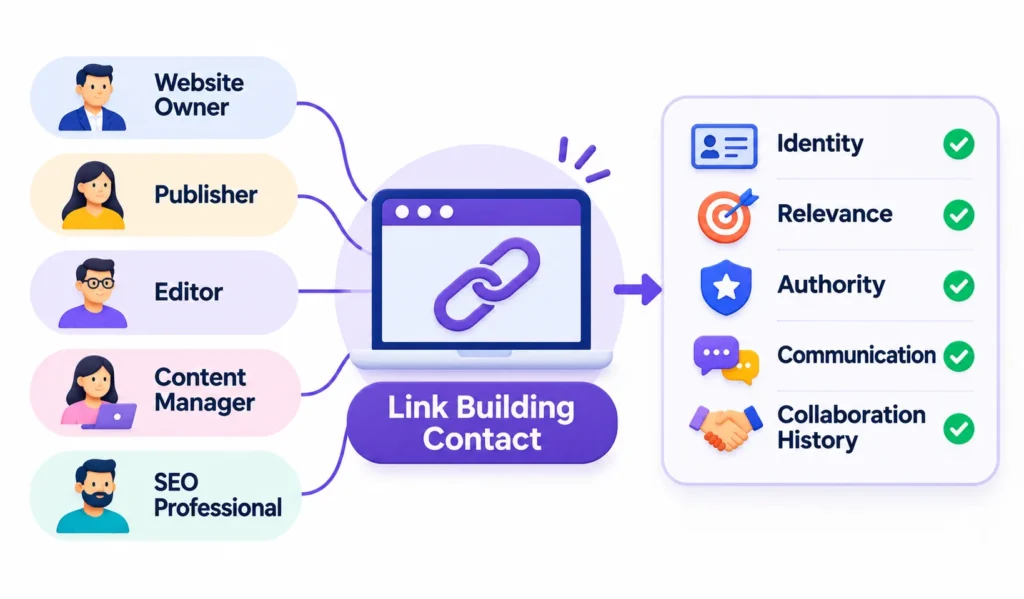
A link building contact is a website owner, publisher, editor, content manager, or SEO professional who can discuss relevant backlink opportunities. Evaluating a contact means checking their identity, website relevance, publishing authority, communication quality, and history of legitimate collaborations before you start outreach.
These roles are not interchangeable. An owner can say yes to almost anything. An editor controls what runs. A content manager may only schedule posts. An SEO manager might be a gatekeeper or simply a middleman.
2. Why Contact Evaluation Matters Before Outreach
A few minutes of checking up front prevents most of the pain later.
- You avoid partnerships with sites your audience would never read.
- You stop wasting outreach on people who cannot approve a placement.
- You spot real editorial opportunities and skip pay-to-play schemes.
- You protect your own site’s reputation.
- You build a short list of people worth a long-term relationship.
The stakes are real. Google’s spam policies define link spam as creating links to or from a site mainly to manipulate rankings. That covers buying and selling links that pass ranking credit, and it covers excessive link exchanges. Google has also said it may simply ignore outbound links from sites that break its spam policies, as Search Engine Roundtable reported in April 2026. A bad partner can cost you money and deliver nothing.
3. Contact Evaluation vs. Contact Discovery
Discovery and evaluation are two different jobs. Mixing them up is why so many outreach lists perform badly.
| Contact discovery | Contact evaluation | |
| Question it answers | Who runs or edits this site? | Should I contact this person at all? |
| Typical output | A name and an email address | A score and a go, investigate, or skip decision |
| Main tools | Email finders, About pages, LinkedIn | Backlink tools, content review, profile checks |
| Risk if skipped | Empty list | Wasted outreach and risky links |
How to Evaluate a Website Before Contacting Its Owner
Start with the website, not the person. If the site fails, the contact does not matter. These are the seven checks I run, in order. Together they answer the question “how do you check whether a website is good for backlinks?”
1. Check Topical Relevance
Read the site’s categories and last ten posts. Ask whether your target reader would plausibly visit this site. A bakery blog linking to a payroll tool is a mismatch, even if both mention “business.”
Relevance is about audience, not shared keywords. A small publication read by your exact customers beats a large one read by nobody you care about.
2. Review Organic Traffic and Search Visibility
Traffic tools give estimates, not exact numbers. Look at the trend over 12 to 24 months rather than one snapshot. A steady line is healthy. A sudden spike followed by a crash, or a sharp unexplained drop, deserves a closer look.
Also check whether the pages that rank are on topic. Low traffic alone should not disqualify a site. A young, focused site with a real audience can be a better partner than a bloated one.
3. Analyze Domain Rating and Domain Authority
Domain Rating (DR) comes from Ahrefs. Domain Authority (DA) comes from Moz. Both are third-party estimates of link strength. Neither is a Google ranking factor, and Google does not use them.
Use them to filter a long list quickly. Do not use them to make the final call. A high score on an unrelated or spammy site tells you very little about its value.
4. Examine the Website’s Backlink Profile
Open the site in Ahrefs, Semrush, or Moz Link Explorer and look at referring domains. You want links from varied, relevant sources. Warning signs include:
- Hundreds of links from unrelated foreign-language sites
- Many exact-match commercial anchors
- A burst of links in a few weeks
- Links mostly from sites that look like each other
5. Evaluate Content Quality and Publishing Consistency
Skim recent articles as a reader would. Are they original, specific, and useful? Do they have named authors and real dates? Or do they read like filler, with a dozen unrelated topics in the same month?
A site that publishes on casino, pet food, and crypto in one week is probably hosting links, not building an audience.
6. Review Outbound Links and Existing Placements
Check where the site already links. Are those links tucked naturally inside useful content, or stacked in a block of commercial anchors? Look for obvious sponsored posts with no disclosure.
If every article links to a different unrelated brand, your link would join a crowd that Google may already discount.
7. Check Website Trust and Professional Presentation
Open the About, Contact, and editorial guidelines pages. Look for real people, a real company name, and a way to reach them. Check that the site works, loads reasonably, and looks maintained.
If you cannot tell who runs the site, treat that as a finding. For a deeper background on the topic, Search Engine Journal’s guide to site quality for link building covers purpose, content depth, and credible sources.
How to Verify the Person Behind a Link Building Contact
A good website does not make every person attached to it the right contact. This is the step most guides skip. Here is how to verify a contact in five moves.
1. Identify Their Actual Professional Role
Work out where the person sits. Different roles can offer very different things.
| Role | What they can usually do | What to confirm |
| Website owner or founder | Approve almost anything | That they really own the site |
| Editor | Approve or reject content | Their editorial standards |
| Content manager | Schedule and publish approved pieces | Who signs off on topics |
| SEO manager | Coordinate and negotiate | Whether they control placements |
| Outreach specialist or sales rep | Sell packages | Whether they are an agent or a reseller |
So, who should you contact for link building? Whoever can approve the placement. If you start with a middleman, ask early who makes the final decision.
2. Check Their LinkedIn Profile
Search for the person on LinkedIn. Confirm that their current employer matches the website. Read their job title and past roles. Does their experience fit editing or publishing?
Look for mismatches between their profile and what they told you. A profile created last month, with no history and a stock photo, is a reason to slow down. A profile showing years at the publication, with posts and connections in the industry, is a good sign.
Sales Navigator can help you find decision-makers at a company, but a free profile search is often enough for this step.
3. Verify Their Email Address
Check that the email uses the website’s own domain. An address like editor@yoursite.com is more convincing than a free webmail account claiming to speak for a publication.
Tools such as Hunter can find and verify addresses. Be clear about what that proves: it tells you the mailbox exists, not that the person has any authority. A valid email does not equal a decision-maker.
4. Review Their Website and Professional History
Search their name on the site. Do they have an author page or published articles? Search the name alongside the site in Google. Check for mentions in other publications or past collaborations.
Confirm they are still with the organization. Outdated names on About pages are common, and a bounced email is a cheap way to learn that, but a quick profile check is cheaper.
5. Determine Whether They Have Decision-Making Authority
A contact who can introduce you is not the same as one who can approve a placement. Look for who manages editorial calendars and guest contributions. If a site has a contributor policy, read it.
Avoid assuming that every SEO employee or sales representative controls what gets published. When unsure, ask politely in your first reply. Reputable people will answer plainly.
What Makes a Link Building Contact Trustworthy?
Trust shows up in behavior. A trustworthy contact does these things:
- Communicates clearly. They state their role, explain how collaboration works, and answer direct questions directly.
- Shows a relevant portfolio. They share real examples of sites and placements, and explain the editorial standards behind them.
- Sets realistic expectations. They do not guarantee rankings or promise huge link volumes. They are honest about what links can and cannot do.
- Behaves consistently. They reply professionally, respect agreed terms, and do not rush you.
- Discusses link quality openly. They can explain why their site fits your topic, and they are upfront about paid, sponsored, or exchanged links. Building a reliable link building network also requires consistent quality checks, transparent communication, and long-term relationships with relevant website owners and publishers.
One scenario I see often: two contacts offer the same guest post slot. One answers your questions about editorial review and shows past posts. The other replies with a price list. The first is usually the safer partner, even if the second has a bigger number next to the domain.
Red Flags to Watch for Before Connecting With Link Building Contacts
Any one of these is a reason to pause. Several together mean walk away. If you are wondering how to identify a link building scam, start here.
| Red flag | Why it matters | What to do |
| Guaranteed rankings | No one outside Google controls rankings, so the promise is empty | Reject |
| Unrelated publishing topics | The site likely exists to host paid links | Skip the site |
| High DR or DA with little real audience | Metrics can be inflated; traffic is the reality check | Check traffic trend and content before deciding |
| Fake or inconsistent identity | Mismatched names, new profiles, or unrelated email domains | Verify through the site or LinkedIn, or reject |
| Backlink packages | Fixed link counts, unnamed sites, and no editorial review | Ask for site names; reject if refused |
| Heavy exact-match anchor demands | An unnatural pattern that looks manipulative | Decline the anchor request |
| Reciprocal link swaps at scale | Google lists excessive link exchanges as link spam | Avoid, or keep exchanges rare and natural |
| Pressure to pay immediately | Due diligence should come before money | Pause until you have verified everything |
A Note on Paid Links and Link Exchanges
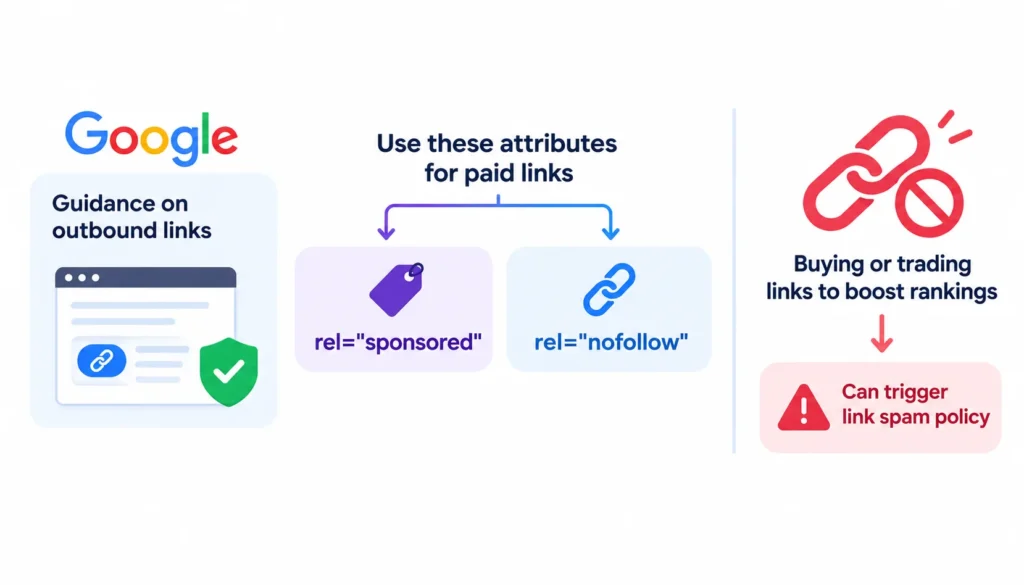
Google’s guidance on qualifying outbound links says paid placements should use the rel=”sponsored” attribute, and that rel=”nofollow” is also an accepted option. Links bought or traded mainly to boost rankings can fall under the link spam policy.
This does not make every paid or sponsored placement forbidden. It means the arrangement should be transparent and the link labeled correctly. If a contact refuses to discuss this, treat that as a red flag.
For wider context on the history, Wikipedia’s article on link building explains how search engines have treated manipulative linking over time. You can also see how practitioners talk about real-world experiences in SEO on Reddit, though treat anecdotes there as opinions, not rules.
Tools to Evaluate Link Building Contacts and Websites
You do not need every tool. Pick one backlink tool, one contact tool, and use free checks for the rest. Treat all traffic and authority figures as estimates.
| Tool | Main use | Best stage |
| Ahrefs | Backlink profile, referring domains, traffic estimates, DR | Website evaluation |
| Semrush | Backlink analytics, competitor research, organic visibility | Website evaluation |
| Moz Link Explorer | Domain Authority, linking domains | Quick filtering |
| Hunter | Finding and verifying professional emails | Contact verification |
| Role, employer, and history checks | Contact verification | |
| Google Search | Author pages, site mentions, indexed content | Both stages |
A simple Google check goes a long way. Search for the site with a topic you care about, then search for the contact’s name with the site’s name. You will often see their published work, interviews, or complaints within a minute.
You can also use a backlink management platform to organize link-building activities, monitor backlink status, evaluate link quality, and manage collaboration opportunities in one place.
How to Score and Prioritize Link Building Contacts
Gut feeling does not scale. A simple scorecard makes your decisions consistent and easy to explain to a client or teammate.
Create a Practical Contact Evaluation Scorecard
Rate each factor from 0 to 10, multiply by its weight, and add the results. These weights are suggested internal values, not official Google metrics. Adjust them for your niche.
| Evaluation factor | Weight |
| Website topical relevance | 25% |
| Website content quality | 20% |
| Organic traffic and audience quality | 15% |
| Backlink profile and outbound link quality | 15% |
| Contact identity and role verification | 15% |
| Communication and transparency | 10% |
| Total | 100% |
How to Interpret the Contact Score
Multiply your weighted result by 10 to get a score out of 100. The cutoffs below are my own working rules, so change them if your results suggest otherwise.
- 70 and above: Suitable for personalized outreach.
- 45 to 69: Investigate further before connecting.
- Below 45: Reject or deprioritize.
Example of Evaluating Two Different Contacts
The scores below are illustrative.
- Contact A runs a site with a high DR, but it covers unrelated topics and links out to many commercial pages. The person’s role is unclear.
- Contact B runs a site with a moderate DR, a relevant audience, and good content. Their LinkedIn profile confirms they are the editor.
| Factor (weight) | Contact A | Contact B |
| Relevance (25%) | 2 | 9 |
| Content quality (20%) | 3 | 8 |
| Traffic and audience (15%) | 6 | 5 |
| Backlinks and outbound links (15%) | 2 | 7 |
| Identity and role (15%) | 3 | 9 |
| Communication (10%) | 4 | 8 |
| Score out of 100 | 31.5 | 78 |
Contact A lands in the reject zone even though the domain looks impressive. Contact B is the stronger prospect despite weaker third-party metrics. That is why a high DR alone is never enough.
Questions to Ask Before Starting a Link Building Partnership
If a contact passes your checks, a few direct questions can settle what is left. Keep them polite and specific.
About website quality
- Which websites do you manage or represent?
- Can you share examples of previous placements?
- How do you maintain editorial quality?
About their authority
- Are you responsible for editorial or publishing decisions?
- Do you manage the website directly?
- Who approves backlink placements?
About collaboration
- What collaboration opportunities are available?
- What are your content requirements?
- How do you handle paid or sponsored placements?
- What happens if a published link is removed?
About transparency
- Can I review the website before agreeing?
- How do you choose the sites you work with?
- Are there any conditions or limits I should know about?
Clear, calm answers are a good sign. Vague replies, avoidance, or irritation at simple questions are not.
How to Connect With a Verified Link Building Contact
Once a contact scores well, your first message should prove you did your homework.
- Personalize it. Mention their site or a specific article, and say why you are writing to them in particular. Generic messages get deleted.
- Lead with value. Offer a relevant content idea or a useful resource for their audience, not a request for a link.
- Keep it professional. Use a clear subject line, keep the message short, and make no unrealistic promises.
- Follow up gently. One or two polite follow-ups spaced several days apart is a sensible pattern. Add something useful each time, and accept silence as an answer.
- Track everything. Record who you contacted, when, and what they said.
There is no universal reply rate to aim for. Results depend on your niche, your message, and how well you qualified the contact in the first place. A smaller list of well-checked contacts almost always beats a large untargeted one.
How to Maintain a Reliable Link Building Contact Database
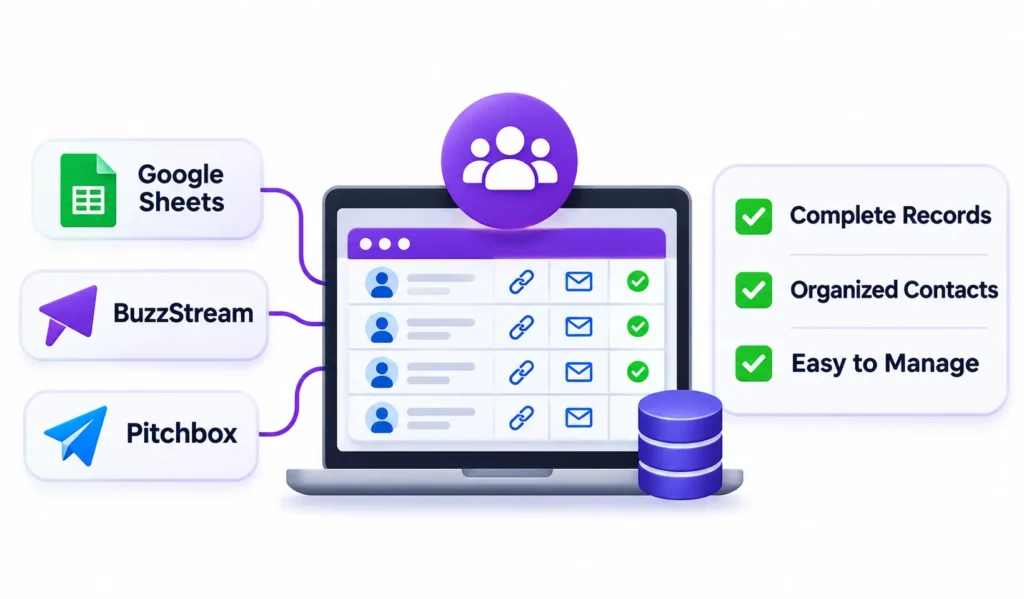
A spreadsheet is enough. Google Sheets works fine, and tools like BuzzStream or Pitchbox add automation if you need it. What matters is that every record is complete. If you’re deciding when to move beyond manual tracking, this guide to backlink tracking spreadsheet vs. software explains the differences and helps you choose the right approach.
Track these fields for each contact:
- Website URL and niche
- Contact name and professional role
- Verified email address and LinkedIn profile
- Website quality notes and score
- Collaboration type
- Last contact date and relationship status
Review the list every few months. Remove people who left, recheck sites that may have changed, update roles, and note how past collaborations turned out.
Common Mistakes to Avoid When Evaluating Link Building Contacts
- Choosing contacts based only on DR or DA
- Ignoring website relevance
- Trusting unverified email addresses
- Contacting the wrong decision-maker
- Overlooking suspicious outbound links
- Prioritizing quantity over quality
- Accepting unrealistic promises
- Failing to document past communication
Frequently Asked Questions About Evaluating Link Building Contacts
What is a link building contact?
A person who can discuss backlink opportunities for a website, such as an owner, editor, content manager, or SEO professional.
How do you evaluate a link building contact before connecting?
Check the website’s relevance, traffic trend, content, and backlinks. Then verify the person’s role, profile, and email. Finally, score the opportunity and decide whether to connect, investigate more, or skip.
What metrics should you check before contacting a website owner?
Topical relevance, organic traffic trend, backlink profile, content quality, and outbound links. DR and DA can help you filter, but they are supporting signals only.
How do you verify whether someone owns or manages a website?
Look for their name on the About or author pages, confirm their role on LinkedIn, and check that their email uses the site’s domain. A short, direct question in your first reply can confirm the rest.
Is Domain Rating important when evaluating link building contacts?
It is a useful filter, but not a deciding factor. It is a third-party estimate, not a Google ranking factor, and a high score on an irrelevant site is a weak prospect.
Which tools are best for finding and verifying contacts?
Hunter for emails, LinkedIn for roles and history, and Ahrefs or Semrush for website checks. Google Search is a free and underrated addition.
What are the warning signs of an unreliable link building partner?
Guaranteed rankings, unrelated site topics, vague identity, fixed backlink packages, heavy exact-match anchor demands, and pressure to pay quickly.
Should you contact a website owner, editor, or SEO manager?
Contact whoever can approve the placement. That is usually the owner or editor. An SEO manager can help if they confirm who makes the final call.
How do you score potential link building partners?
Rate relevance, content quality, traffic, backlink quality, identity verification, and communication from 0 to 10, apply weights, and convert to a score out of 100.
How often should you update your contact database?
Review it every few months, and recheck any contact before a new campaign.
Final Thoughts
Knowing how to evaluate link building contacts before connecting is what separates a focused outreach program from a pile of wasted emails. Check the website first. Verify the person second. Look for transparency, and walk away from guarantees and pressure.
A short list of verified, relevant contacts will serve you better than a long list of unqualified ones. Your next step is simple: score every prospect with the scorecard above before you send a single message.