

Link building still matters. Links help search engines discover pages, and they remain one of the signals Google uses to understand which sites are worth trusting.
But the wrong links cost you money, time, and sometimes your visibility. The biggest risk is not one bad website. It is a whole group of sites run to sell links at scale.
This guide shows you how to identify unreliable link building networks, check partners before you pay, and decide with evidence instead of gut feeling.
What Is an Unreliable Link Building Network?
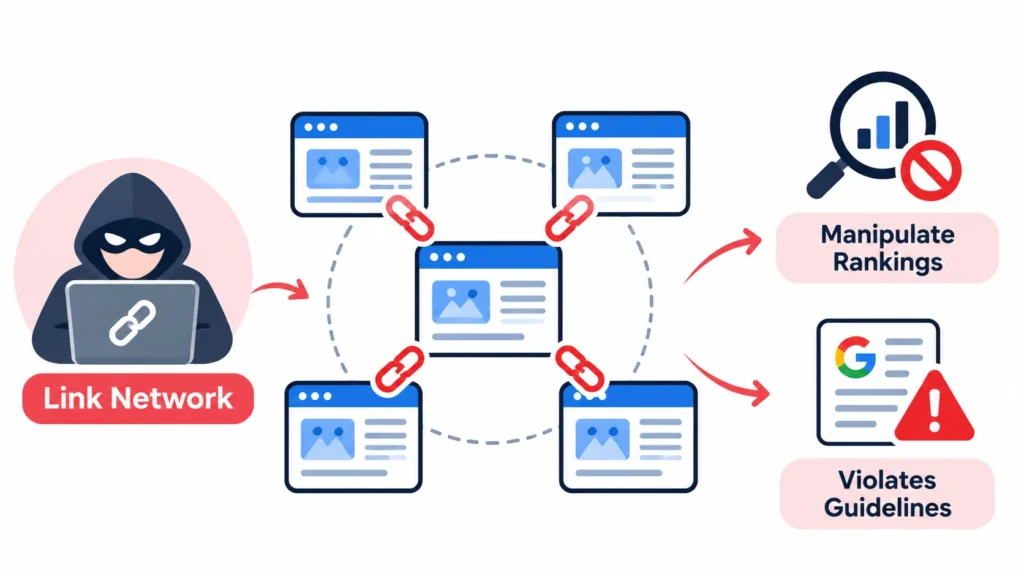
An unreliable link building network is a group of websites, or coordinated publishers, that exists mainly to sell or exchange backlinks that manipulate rankings. These links are placed for the link’s sake, not because they help readers, and they often break search engine guidelines.
A single poor website is a problem. A network is a bigger one, because the same people may control dozens of sites, all pushing the same kind of links.
That is why checking one site at a time is not enough. You also need to look at how the sites connect. Understanding the difference between manipulative networks and legitimate partnerships is essential when building a strong link building network based on relevant websites and trusted industry relationships.
How Unreliable Link Building Networks Operate
Most networks follow the same simple model. Someone builds or buys a set of websites, gives them a believable look, and sells guest posts or link placements to anyone who pays.
The sites may carry decent-looking metrics. Some use expired domains that already had backlinks. Others buy links to the network’s own sites to push up their authority scores.
The goal is to look valuable to you, the buyer. Whether the sites are valuable to readers matters little to the operator.
Common Types of Manipulative Link Building Networks
You will run into a few main types. Their names get mixed up often, so here is how they differ.
- Private Blog Networks (PBNs). A set of websites controlled by one person or group, built to link to a “money site” and pass authority. Wikipedia’s article on link farms covers the wider history of this tactic.
- Link farms. A large group of pages or sites that link to each other with no real editorial purpose. Quantity is the point.
- Automated link networks. These use software to create links in bulk, such as comments, profiles, or auto-generated pages. Google lists automated link creation as link spam.
- Manipulative guest posting networks. These sell guest posts across hundreds of unrelated sites, usually with keyword-rich anchor text. Guest posting is not bad by itself. Doing it at scale just to place links is the problem.
- Excessive reciprocal exchange networks. Groups where everyone links to everyone else (“link to me, I’ll link to you”) on a large scale. A few natural partnerships are fine. Systematic swapping is not.
Legitimate Link Building Partnerships vs. Unreliable Networks
Not every paid or exchanged link is a scam. The difference is in how the relationship works.
| Evaluation Factor | Reliable Partner | Unreliable Network |
| Website relevance | Related topics | Random niches |
| Content | Original and useful | Generic or duplicated |
| Traffic | Relevant organic visitors | Artificial or unexplained patterns |
| Backlinks | Natural and diverse | Manipulated patterns |
| Ownership | Transparent | Hard to verify |
| Outbound links | Editorially relevant | Excessive commercial links |
| Partnerships | Relevant collaborations | Coordinated link manipulation |
Why Should You Avoid Unreliable Link Building Networks?
Short answer: the upside is small and the downside is real. Here is what you risk.
1. Increased Risk of Violating Google’s Link Spam Policies
Google’s spam policies name link spam directly. That includes buying or selling links that pass ranking credit, excessive link exchanges, automated link creation, and large-scale guest posting campaigns with keyword-rich anchors.
Google says its systems can neutralize many spammy links automatically. In more serious cases, a site can receive a manual action.
2. Wasted Link Building Budget
If Google simply ignores the links, you have still paid for them. This is the most common outcome, and the quietest one. Nothing breaks. Nothing improves either.
3. Low-Quality or Irrelevant Backlinks
A link from a site that covers casinos, pet food, and software in the same week tells search engines very little about your business. It tells readers even less.
4. Unstable Link Placements and Link Removal
Networks get shut down, sold, or cleaned up. Links vanish. I have seen clients pay for a batch of placements and find half of them gone within a few months.
5. Potential Damage to Website Reputation
Your link profile is part of how others perceive you. Being tied to obvious link-selling sites can hurt trust with partners, journalists, and customers.
Keep this in perspective, though. Not every low-quality link is harmful, and Google does not penalize you for every bad link pointing your way. The real danger is a pattern of paid, manipulative links you chose to build.
12 Warning Signs of an Unreliable Link Building Network
No single sign proves anything. Treat each one as a reason to look closer. When several appear together, the picture gets clear fast.
1. Websites Publish Content Across Unrelated Niches
A real publication has a focus. A site that covers crypto, dental care, fashion, and home loans, all with guest posts, usually exists to sell space.
Some legitimate sites do cover broad topics, like general news or lifestyle sites. Check whether the articles show real editorial thinking or just fill slots.
2. Multiple Websites Share Similar Designs and Templates
Look at the layout, footer, fonts, menu structure, and page templates across the sites offered to you. Many sites using one popular theme is normal. The same theme plus the same footer text plus the same page structure is a pattern worth noting.
3. Suspicious Organic Traffic Patterns
Watch for sharp jumps, sudden drops, or traffic that does not match the site’s topic. A cooking blog getting most of its visits from a country it never targets is odd.
Traffic tools give estimates, not exact numbers. Use them to spot oddities, not to prove anything.
4. Artificially Inflated Domain Rating and Domain Authority
Domain Rating (Ahrefs) and Domain Authority (Moz) are third-party scores. Google does not use them to rank pages.
They can be pushed up with purchased links. If a site has a high score but almost no organic keywords or traffic, ask why.
5. Excessive Commercial Outbound Links
Open a few recent articles. If nearly every post links out to a different business, often in unrelated industries, the site is probably selling links to anyone.
6. Repeated Anchor Text Patterns Across Multiple Websites
Natural links use mixed anchors: brand names, bare URLs, and plain phrases. If you see the same exact-match commercial phrase repeated across many posts or sites, that is a red flag.
7. Identical or Low-Quality Content Across Domains
Paste a few sentences from an article into a search engine in quotes. Duplicate or lightly spun text across several sites is a bad sign. So is thin, generic writing that says nothing a reader couldn’t find anywhere.
8. No Verifiable Website Ownership or Editorial Team
Check the About page, author bios, and contact details. Stock-photo authors, no company name, and no real way to reach anyone are warning signs.
Privacy is not always suspicious. But a site selling placements should be willing to say who runs it.
9. Unnatural Interlinking Between Portfolio Websites
If the sites you are offered keep linking to each other, especially from unrelated topics, they may be run together. Check each site’s outbound links and see whether they point to sister sites.
10. Suspicious Referring Domain Profiles
Look at who links to the site. Piles of links from unrelated, low-quality sites, or sudden bursts of new links, can show that its authority was bought.
11. Frequent Changes in Website Topics and Identity
A site that was a Spanish recipe blog two years ago and is now an English finance site may be a repurposed expired domain. Google lists expired domain abuse in its spam policies, so this matters.
12. Unrealistic Link Building Offers and Guaranteed Results
Nobody can guarantee rankings. Be careful with promises like “100 links in a week” or “DR 70+ sites for a tiny fee.” Cheap, fast, and high-authority rarely go together.
How to Investigate Whether Multiple Websites Belong to the Same Link Building Network
This is the step most people skip. Each site may look fine alone. The connections are what give a network away.
1. Check Shared Website Ownership Information
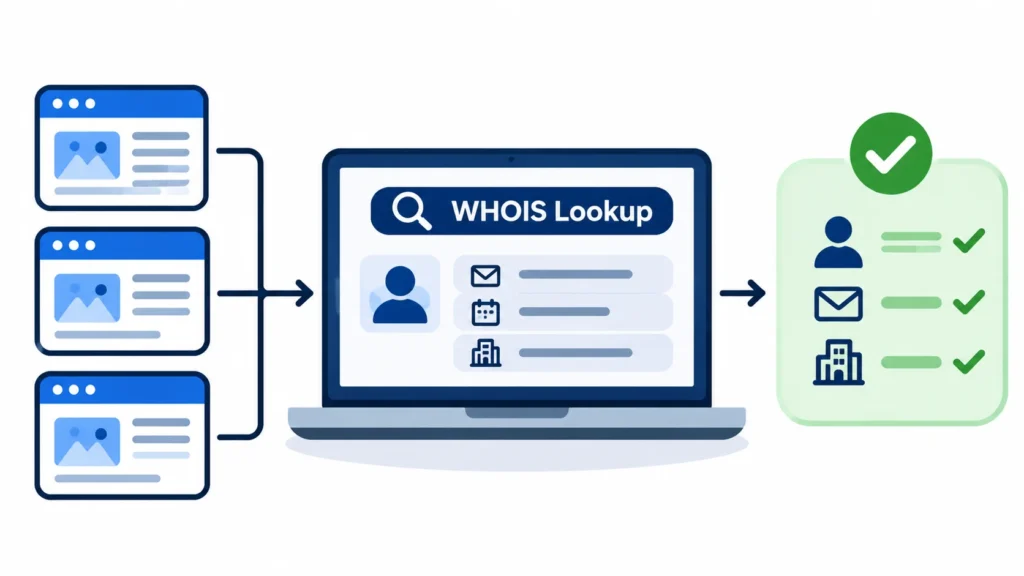
Use a WHOIS lookup to see registration details. Many sites hide this behind privacy services, so an empty result proves nothing. When details are visible, matching names, emails, or organizations across sites are a useful clue.
You can also learn how to find relevant website owners and publishers through About pages, author profiles, company information, and other publicly available records.
2. Compare Author Profiles and Editorial Teams
Search the author names. Do the same people appear on several unrelated sites? Do their photos show up elsewhere under different names? A reverse image search helps here.
3. Investigate Shared Contact Information
Compare email formats, phone numbers, contact forms, and addresses. Repeats across “independent” sites are worth noting.
4. Analyze Similar Website Structures
Compare URL patterns, category names, footer text, and how articles are formatted. Operators often reuse what works.
5. Compare Referring Domains and Outbound Links
In a backlink tool, check whether the sites share many of the same referring domains. Then compare where they link out. Overlap in both is a stronger signal than overlap in one.
6. Look for Repeated Cross-Linking Patterns
Map the links between the sites. A tidy web of links between “unrelated” sites suggests coordination.
7. Investigate Historical Website Changes Using the Wayback Machine
The Wayback Machine shows old versions of a site. Look for a sudden change in topic, language, design, or ownership. That often points to an expired domain being reused.
8. A Practical Example: Five Sites That Look Independent
Say a seller offers you these five sites:
| Website | DR | Monthly Traffic | Main Topic |
| Website A | 58 | 12,000 | Technology |
| Website B | 55 | 10,500 | Finance |
| Website C | 57 | 11,000 | Travel |
| Website D | 56 | 9,800 | Marketing |
| Website E | 54 | 12,500 | Health |
On their own, these numbers look healthy. They are also oddly similar, but that alone proves nothing.
Now suppose your checks show the same template on all five, the same author names, overlapping backlink sources, and links passing between the sites. Taken together, that is a strong reason to suspect common ownership or coordination.
One caution: shared hosting, a shared theme, or shared infrastructure alone does not prove anything. Many honest sites share them. What matters is several independent signals pointing the same way.
How to Analyze Website Quality Before Accepting a Backlink
Once a site passes the network checks, look at its quality. Here is what I check, and which tool helps.
| What to Check | Tool to Use | Warning Signs to Investigate |
| Organic traffic and keywords | Semrush, Ahrefs | Traffic with no matching rankings |
| Backlink profile | Ahrefs, Majestic | Sudden spikes, irrelevant sources |
| Spam signals | Moz | High spam score plus other red flags |
| Indexation | Google site: search | Few or no pages indexed |
| Outbound links | Screaming Frog, manual review | Many paid-looking links |
| Content quality | Manual reading | Thin, duplicated, or off-topic posts |
| Technical health | Screaming Frog | Broken pages, redirect chains, blocked crawling |
Check Organic Traffic and Keyword Rankings
Look at the keywords a site ranks for. Real sites rank for terms related to their topic. Traffic with no sensible keywords behind it deserves a second look.
Analyze the Backlink Profile and Referring Domain Quality
You want variety: different types of sites, natural anchors, and steady growth. Be wary of sharp spikes and unrelated sources.
Check Domain Rating, Domain Authority, Spam Score, and Trust Flow
Use these as rough guides only. A high spam score does not make a site bad, and a high DR does not make it good. I avoid fixed cutoffs like “DR 30 or above” because they ignore context.
Examine Outbound Link Patterns and Verify Indexation
Search site:example.com in Google. If a site that claims to have hundreds of articles shows almost nothing indexed, something is wrong. Also scan outbound links for patterns of paid placements.
Evaluate the Actual Page
The page that will carry your link matters more than the homepage. Check that it is indexed, relevant to your topic, placed within real content, and not stuffed with other outbound links.
Best Tools to Identify Unreliable Link Building Networks
You do not need every tool. Pick a few and learn them well.
| Tool | Main Purpose | What to Investigate |
| Ahrefs | Backlink analysis | DR, referring domains, anchors |
| Semrush | SEO analysis | Traffic, Authority Score, keywords |
| Moz | Domain evaluation | DA and Spam Score |
| Majestic | Link quality | Trust Flow and Citation Flow |
| Google Search Console | Backlink monitoring | Linking sites and manual actions |
| Wayback Machine | Historical research | Previous website content |
| Screaming Frog | Technical audit | Indexability and technical issues |
Remember that each tool uses its own data and its own scoring. Their numbers will not match, and none of them is Google’s view of a site. Use them to compare and investigate, not as final answers.
Google Search Console is the only source of Google’s own data about your site. It shows which sites link to you and tells you if a manual action has been applied.
How to Vet a Link Building Agency or Exchange Partner
Networks are often sold through agencies and brokers. Here is how I screen them. Before choosing a service provider, learn how to find reliable link builders who prioritize website relevance, transparent practices, and genuine editorial placements.
1. Verify the Websites in Their Portfolio
Ask for the full list of sites before you pay. If they refuse or only show a “menu” of names without URLs, be careful.
2. Ask About Ownership and Management
A good partner can explain whether they own the sites, manage them, or work with outside publishers. Vague answers are a warning.
3. Request Examples of Previously Published Backlinks
Ask for live links on real pages. Then check them: are they still there, indexed, and on relevant content?
4. Evaluate Their Methods and Policies
Ask how they find sites, how they approve content, and whether they label paid links. A reputable provider has clear answers.
5. Check Placement and Removal Conditions
Find out how long links stay live, what happens if they are removed, and whether you get a replacement or refund. Put it in writing.
6. Watch for Unrealistic Guarantees and Pricing
Guaranteed rankings, huge packages, or very low prices per link usually point to bulk network placements. Use screenshots only as a starting point, since they are easy to fake. Ask for live URLs.
7. Review Communication and Transparency
Notice how they treat basic questions. Honest partners answer clearly. Evasive ones push you to pay first.
A Step-by-Step Framework to Audit a Link Building Network
Here is the process I follow. It works for agencies, brokers, and one-off site owners.
- Collect all websites offered. Get the full list of URLs, not just names or screenshots.
- Review topical relevance. Does each site fit your industry or a clearly related one?
- Analyze traffic and SEO metrics. Check traffic trends and the keywords behind them.
- Investigate backlink and outbound link profiles. Look for odd spikes, irrelevant sources, and heavy commercial linking.
- Identify shared footprints. Compare templates, authors, contacts, backlinks, and cross-links.
- Review content quality and editorial standards. Read real articles. Would you trust this site as a reader?
- Verify ownership and contact details. Confirm that real people stand behind the site.
- Classify each site by risk.
| Risk Level | Website Characteristics | Recommended Action |
| Low Risk | Relevant content, genuine audience, transparent ownership | Consider collaboration |
| Medium Risk | Some suspicious signals that need checking | Investigate further |
| High Risk | Multiple manipulative patterns and poor editorial standards | Avoid collaboration |
This is a practical screening method of my own, not an official Google classification. Use it to organize your decisions and keep notes for each site.
Common Mistakes to Avoid When Evaluating Link Building Networks
- Relying only on Domain Rating. It is one third-party number. It can be inflated.
- Assuming high traffic means high quality. Traffic can be irrelevant, bought, or from keywords unrelated to the site.
- Ignoring outbound links. Who a site links to tells you as much as who links to it.
- Accepting links without checking relevance. An off-topic link rarely helps and can look unnatural.
- Trusting screenshots over verifiable data. Ask for live pages you can check yourself.
- Assuming every low-quality backlink is harmful. Google says its systems are good at ignoring spammy links on their own. Not every odd link needs action.
- Disavowing without investigation. Google’s disavow guidance says the tool is for cases where you have a considerable number of unnatural links and a manual action, or are likely to get one. It is not a routine fix for every suspicious link.
How to Protect Your Website From Unreliable Link Building Networks
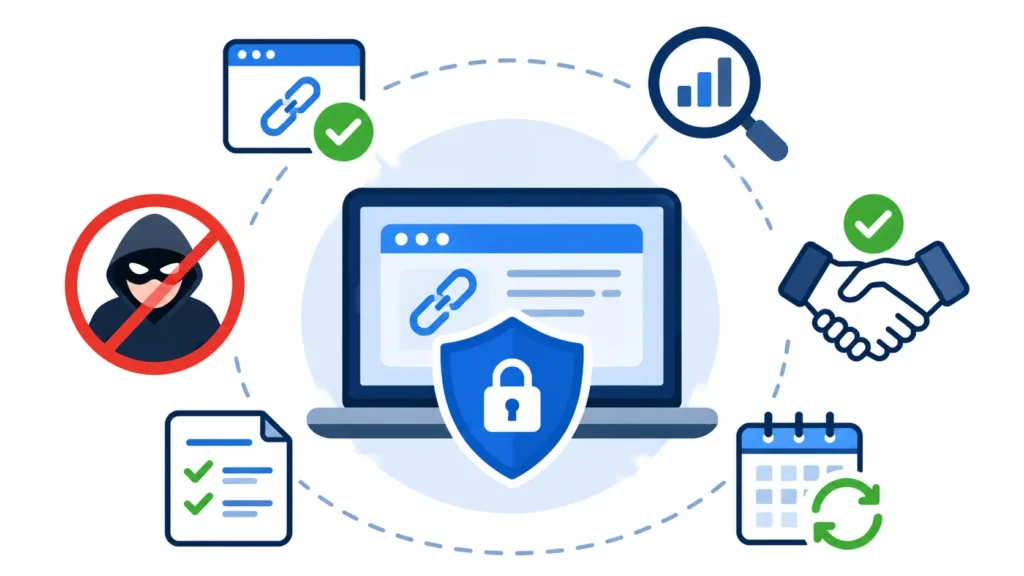
A few habits make a big difference.
- Build relationships with relevant site owners. Real connections with people in your industry beat bulk placements every time.
- Maintain a verified website inventory. Keep a list of vetted sites, with notes on traffic, ownership, and past results. Reuse the good ones and skip the rest.
- Prioritize editorially relevant backlinks. Aim for links a real editor would choose to include.
- Monitor new and lost backlinks. Check Google Search Console and your backlink tool regularly for strange new links or sudden losses.
- Document your agreements. Write down what was promised, including link type, duration, and removal terms.
- Run regular audits. A quarterly review is a reasonable starting point for most sites. Do it more often if you build links heavily.
- Follow Google’s link qualification guidelines. Google’s guide on qualifying outbound links explains how to mark links properly.
In practice, that comes down to three rules:
- Use rel=”sponsored” for paid placements and advertising.
- Use rel=”nofollow” when you do not want to pass ranking credit or cannot vouch for the destination.
- Leave natural editorial links unmarked when you truly choose to link.
Google treats sponsorship and advertising as legitimate when the links are labeled correctly. The trouble starts when paid links are meant to pass ranking credit without being marked.
If you want to see how other practitioners discuss this in the wild, the SEO community on Reddit is a useful place to read real experiences. Treat individual opinions there as anecdotes, and verify claims against Google’s own documentation.
Frequently Asked Questions About Unreliable Link Building Networks
What Is an Unreliable Link Building Network?
It is a group of sites or publishers that mainly sells or swaps backlinks to manipulate rankings. The sites often share owners, templates, authors, or linking patterns.
How Can You Identify a Private Blog Network?
Look for shared ownership signals, similar designs, repeated authors, overlapping backlinks, and cross-links between sites. Also check the Wayback Machine for expired domains that changed topic. No single clue is proof, so weigh them together.
What Are the Warning Signs of a Link Farm?
Link farms usually have huge numbers of outbound links, little real content, no clear purpose, and links pointing at other low-quality pages. Their pages exist for linking, not reading.
Can Unreliable Link Building Networks Hurt SEO?
They can. Google may ignore the links, which wastes your money. If you are clearly buying or exchanging links at scale to manipulate rankings, you risk a manual action. Most of the time the damage is wasted effort rather than a penalty.
How Do You Check Whether a Website Is Selling Backlinks?
Look for “write for us” pages with prices, many commercial outbound links in unrelated topics, and posts that read like ads. Searching for the site’s name plus words like “guest post” or “sponsored post” can also help.
Are All Link Exchanges Bad for SEO?
No. Natural partnerships between related sites are normal. Google’s concern is excessive link exchanges done mainly for ranking purposes.
Which Tools Help Identify Suspicious Backlink Networks?
Ahrefs, Semrush, Moz, and Majestic help with link and traffic analysis. Google Search Console shows your own link data. The Wayback Machine and WHOIS lookups help with history and ownership.
Should You Disavow Links From Unreliable Websites?
Usually not. Google advises using disavow only when you have many unnatural links and a manual action, or are likely to get one. For a few odd links, it is generally unnecessary.
How Often Should You Audit Your Link Building Partners?
Check them before you buy and review them regularly afterward, such as every quarter. Look at whether links are live, indexed, and still sitting on healthy sites.
Final Thoughts on Identifying Unreliable Link Building Networks
Surface metrics are easy to fake, so good decisions need more than a DR number. The skill is in looking at how sites relate to each other, who runs them, and whether a real audience would ever care about them.
If you remember one thing about how to identify unreliable link building networks, make it this: judge the connections, not just the site. Check topic relevance, ownership, traffic quality, outbound links, and shared footprints before you agree to any placement.
Good link building stays simple at its core. It rests on relevant sites, useful content, transparent partners, and links that earn their place. Build a repeatable vetting process and use it every time.