
You can have the best content in your niche and still get zero replies. Most of the time, the problem is not the content. It is a conversation.
Learning how to communicate effectively with link building contacts changes your results more than any outreach tool will. Website owners, editors, and SEO managers get dozens of pitches every week. They reply to the people who sound like real, helpful humans.
This guide walks through the full communication lifecycle: finding the right person, starting the conversation, negotiating, handling “no,” and keeping the relationship alive after the link goes live.
What Is Link-Building Communication and Why Does It Matter?
1. Understanding Link-Building Communication
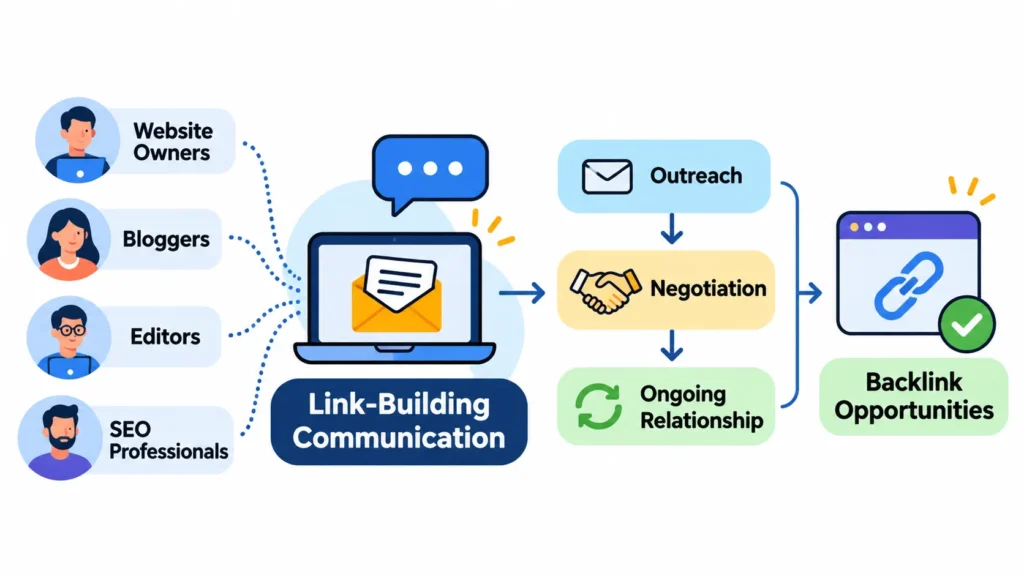
Link-building communication is the process of building and maintaining professional relationships with website owners, bloggers, editors, and SEO professionals. The goal is to create mutually beneficial backlink opportunities through personalized outreach, honest negotiation, and ongoing conversation.
In plain English: it is everything you say to the people who control the websites you want links from. That includes the first email, the follow-up, the price discussion, and the thank-you note.
A backlink is simply a link from one website to another. Link building is the practice of earning those links. Communication is how you earn them.
2. Why Professional Communication Matters
Good communication helps you in five practical ways:
- It builds trust. People link to those they believe are credible.
- It improves reply rates. Relevant, personal messages stand out from templates.
- It surfaces better opportunities. Friendly contacts tell you about openings you would never find in a tool.
- It saves time. A warm contact is faster than a cold prospect.
- It protects your reputation. Site owners talk to each other, and bad behavior travels.
3. How Communication Influences Link-Building Success
Think of every link as the end of a small negotiation. The editor has to decide that your page is worth their readers’ attention. That decision is partly about your content and partly about how you made them feel.
If you were clear, polite, and easy to work with, you are a low-risk partner. If you are vague or pushy, you are extra work. Editors avoid extra work.
How to Identify and Approach the Right Link-Building Contacts
1. Identify Relevant Website Owners and Editors
Start with sites your audience already reads. Ask a simple question: would a reader of this site genuinely find my page useful?
If the answer is yes, you have a relevant prospect. If you have to stretch to explain the fit, skip it. Irrelevant pitches are the fastest way to get ignored.
To improve your outreach targeting, learn how to find relevant website owners and publishers who are more likely to be interested in your link-building proposals.
2. Research Contacts Before Reaching Out
Spend five minutes on research before you write a word. Check these things:
- What does the site publish, and how often?
- Is the content original and well edited?
- Does the site already link out to sources like yours?
- Has the person you plan to contact written or shared anything recently?
- Does the site have a contributor or guest post page?
Before initiating a conversation, follow a structured process for evaluating link-building contacts to verify their website relevance, credibility, publishing authority, and collaboration potential.
Tools like Ahrefs, Semrush, and Moz can show you traffic and backlink data. Use them to filter out spammy sites. Do not use them as a replacement for actually reading the site.
3. Find the Right Person to Contact
The wrong recipient kills a good pitch. Match your message to the role:
| Contact type | What they care about | Best approach |
| Website owner or blogger | Their audience and their voice | Short, personal, specific to their content |
| Content editor | Quality, fit, deadlines | Clear topic idea and editorial standards |
| SEO manager | Value, risk, results | Mutual benefit, transparency, data where useful |
| Marketing manager | Brand, campaigns | Co-marketing or content collaboration angle |
| Link-building agency | Volume, pricing, process | Clear terms, rates, and turnaround |
| Freelance link builder | Reliability, fair pay | Direct, respectful, long-term view |
Check the About page, the author bylines, and LinkedIn. A small blog is usually run by one person. A larger publication will have an editor or partnerships lead.
4. Choose the Right Communication Channel
Email is the default, but it is not always the best option. Here is a quick comparison:
| Channel | Best for | Watch out for |
| First contact, formal proposals, terms | Crowded inboxes, spam filters | |
| Warming up a contact, reaching editors and SEO managers | Overly salesy connection notes | |
| Industry communities (Slack, Discord, Reddit) | Building reputation and finding partners | Community rules against self-promotion |
| WhatsApp or direct chat | Existing partners who already prefer it | Do not use it for cold outreach |
Communities such as SEO and bigseo on Reddit are useful for learning how practitioners talk about outreach. Read the rules before you post anything. Many forbid link requests and promotion.
On LinkedIn, a short, personal connection note followed by a few weeks of genuine interaction often works better than a cold pitch. Comment on their posts first. Ask for something later.
How to Start a Professional Conversation With Link-Building Contacts
1. Introduce Yourself and Your Website Clearly
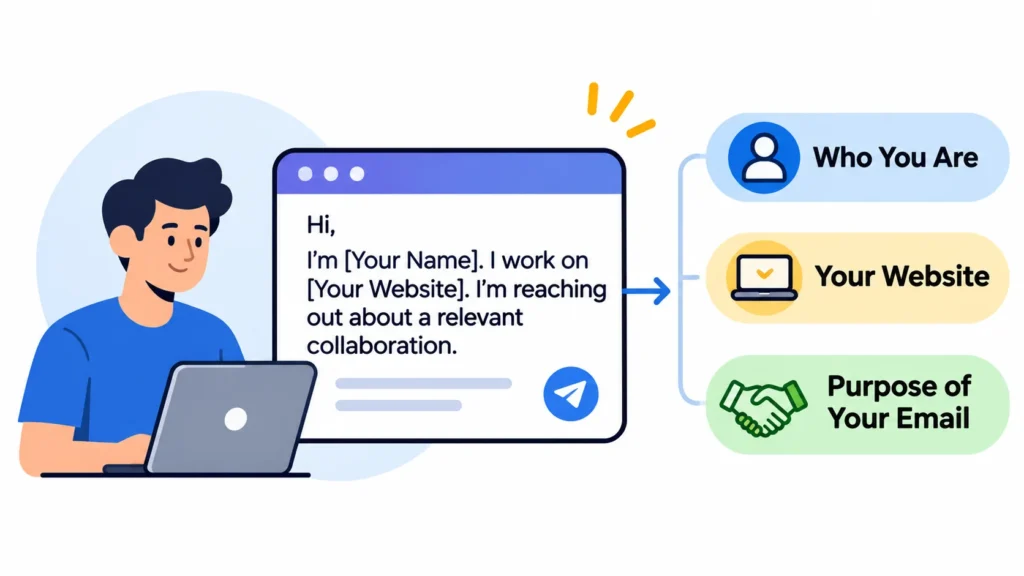
Keep your intro to one or two sentences. State who you are, what you work on, and why you are writing.
Do not write your life story. Busy people want to know one thing: why is this email in my inbox?
2. Personalize Your First Message
Real personalization goes beyond using their first name. Mention something specific, such as:
- A recent article you found useful.
- A point you agreed or disagreed with.
- A gap you noticed in a resource page.
- A shared connection or community.
One genuine sentence beats three generic compliments. If you cannot find anything real to say, you probably have the wrong prospect.
3. Lead With Value Instead of Asking for Backlinks
Open with what you can give. That might be a useful resource, a correction, a fresh statistic you can point to, or a topic idea for their audience.
Ask for the link only after the value is clear. Often it is better to ask a small question first, like whether they would be open to a guest contribution.
4. Avoid Generic and Overly Promotional Messages
Here is a weak opening and a better one.
Weak:
Hi there, I love your blog! We have an amazing article on digital marketing. Please link to us. Thanks!
Better:
Hi Priya, I read your guide to email deliverability last week. The section on DMARC setup was clear, and I noticed it does not cover reply-rate tracking. I wrote a short piece on that. Would it be useful for your readers?
The second message is specific, short, and respects her time. It also gives her an easy yes or no.
How to Write Effective Link-Building Outreach Emails
1. Write Clear and Relevant Subject Lines
A good subject line is short, honest, and specific. Avoid clickbait and all-caps.
Examples that work well:
- “Idea for your email deliverability guide”
- “Quick question about your resource page”
- “Guest post idea for [Site Name]”
- “Update for your article on [topic]”
Avoid “Partnership opportunity!!!” or “Quick favor.” They look like spam.
2. Follow a Simple Outreach Email Structure
Use this five-part structure for most cold emails:
- Personalized greeting. Use their name.
- Relevant introduction. One line on who you are.
- Specific opportunity. What you are suggesting.
- Mutual value. Why does it help their readers or site?
- Clear call to action. One easy next step.
3. Keep Your Emails Short and Professional
Aim for a message someone can read in under thirty seconds. Use short paragraphs and plain words.
Skip long company histories and attachments. Do not use heavy formatting. A plain, friendly email looks more human and is also less likely to trigger spam filters.
4. Personalize Emails Based on the Recipient
An editor wants to know the topic, angle, and your standards. A website owner wants to know why this helps their audience. An SEO manager wants clarity on terms and risk.
Change one or two lines for each person. That small effort shows you did your homework.
5. Link-Building Outreach Email Examples
Adapt these to your own voice. Never send a template unchanged.
Template 1: Guest post pitch
Subject: Guest post idea for [Site Name]
Hi [Name],
I’m [Your Name], and I write about [topic]. I enjoyed your recent piece on [article title], especially [specific point].
I’d like to suggest a guest article called “[Working Title].” It would cover [two or three key points] and would be written for your readers, not for us. I’m happy to follow your editorial guidelines.
Would you like me to send a short outline?
Thanks, [Name]
Template 2: Link insertion request
Subject: Update for your article on [topic]
Hi [Name],
I was reading “[Article Title]” and found it helpful. In the section on [topic], I noticed a link to [old or weaker resource]. I recently published [your resource], which covers [what’s new or more complete].
If you think it fits, it might be a useful addition for readers. Either way, thanks for a great article.
Best, [Name]
Template 3: Content collaboration
Subject: Joint resource idea
Hi [Name],
Our audiences overlap on [topic]. I’ve been thinking about a short joint guide on [subject], where each of us contributes a section and shares it with our readers.
Would you be open to a quick chat about it?
[Name]
Template 4: Link exchange (use with care)
Only propose an exchange when both pages are genuinely relevant to each other’s readers. Do not make it the first thing you ask.
Subject: Resource suggestion
Hi [Name],
Your page on [topic] and our guide on [related topic] seem to help the same readers. If you find ours useful, feel free to reference it. I’d also be glad to point readers to your page where it fits naturally in our content.
No pressure either way.
[Name]
Template 5: Partnership introduction
Subject: Introduction from [Your Company]
Hi [Name],
I manage content at [Company]. We’re building relationships with a small group of publishers in [niche] and I admire your work on [topic].
If you ever need a contributor, a data point, or a second opinion on a piece, I’d be glad to help. No request here, just an introduction.
[Name]
How to Communicate and Negotiate Different Link-Building Opportunities
Negotiation in link building is not about winning. It is about agreeing on a fair exchange that both sides are happy to repeat.
Be open about what you are offering, what you expect, and what you cannot do. Honest terms prevent most disputes.
1. How to Discuss Guest Post Opportunities
Ask for the editorial guidelines first. Then confirm the basics:
- Topic and angle.
- Word count and format.
- Who handles images and edits.
- Publishing timeline.
- Author bio and link rules.
Send an outline before you write the full article. It protects both sides from wasted effort. A guest post should earn its place because it is useful to readers, not just because it carries a link.
2. How to Negotiate Link Insertions
A link insertion adds your link to an existing article. Keep the conversation focused on the reader:
- Point to the exact paragraph where the link fits.
- Explain what your resource adds.
- Suggest natural anchor text, and accept their edits.
- Confirm the target URL.
Do not push for a specific anchor if the editor prefers another. Their site, their call.
3. How to Discuss Reciprocal Link Exchanges
Google’s link spam policies warn against excessive link exchanges done purely for ranking. A natural, relevant mention between two useful pages is different from a large-scale swap.
If you propose an exchange, keep it small, relevant, and optional. If the other person is not interested, move on.
4. How to Negotiate Three-Way Link Exchanges
In a three-way exchange, Site A links to Site B, and Site B links to Site C, rather than a direct swap. These arrangements can look like link schemes when they are done at scale or without editorial value.
I do not recommend building a strategy around them. If a partner suggests one, ask whether each link would still make sense for readers without the exchange. If not, decline politely.
5. How to Discuss Paid Link Placements
Paid placements are common, but they need extra care. Google’s guidance says links that are paid for should be marked with a sponsored or nofollow attribute. You can read more in Google’s guide to qualifying outbound links, and learn the basics of nofollow on Wikipedia.
When discussing paid work, be direct about:
- The price and what it includes.
- Whether the content is labeled as sponsored.
- The link attribute.
- Payment timing.
- What happens if the link is removed.
Do not promise ranking results. Nobody can guarantee them.
6. How to Communicate Collaboration Terms Clearly
Put the key details in writing before work starts. A short checklist prevents most misunderstandings:
| Term | What to confirm |
| Target URL | The exact page being linked to |
| Anchor text | Agreed wording, or editor’s choice |
| Host page | Which article or page carries the link |
| Content requirements | Length, format, tone, originality |
| Publishing timeline | Expected date, and who updates whom if it slips |
| Payment terms | Amount, method, and when it is due |
| Link attributes | Follow, nofollow, or sponsored |
| Placement confirmation | The live URL, sent after publishing |
Send this as a friendly recap: “Just to confirm what we agreed…” It feels collaborative, not legalistic.
How to Follow Up With Link-Building Contacts Without Being Annoying
1. When Should You Send Your First Follow-Up?
Wait about four to seven days. People are busy, and most messages are missed rather than rejected.
Keep the follow-up short and add something new. A new idea, a relevant update, or a simple clarification works better than “just checking in.”
2. How to Write a Professional Follow-Up Message
Subject: Re: Guest post idea for [Site Name]
Hi [Name],
Following up in case my note got buried. I also put together a short outline for the topic, in case that helps you decide. Happy to adjust the angle if you have something else in mind.
Thanks for your time, [Name]
3. How Many Times Should You Follow Up?
A reasonable sequence is one initial email and two follow-ups, spaced about a week apart. After that, stop.
| Step | Timing | Goal |
| Initial email | Day 0 | Introduce the idea |
| Follow-up 1 | Day 5 to 7 | Add a small piece of value |
| Follow-up 2 | Day 12 to 14 | Polite final nudge, make it easy to say no |
If you hear nothing after that, let it go. You can try again months later with a new reason to write.
4. How to Reconnect With Contacts Who Have Stopped Responding
Silence is not always a no. Wait a few months, then write with something fresh: a new resource, an industry update, or a note on something they published.
Hi [Name], it’s been a while. I saw your recent piece on [topic] and thought of our earlier chat. If it’s still useful, I’d be glad to pick it back up. If not, no worries.
How to Handle Rejections and Difficult Conversations
Rejection is part of the job. How you respond decides whether the door stays open.
1. What to Say When Someone Rejects Your Link-Building Request
Reply once, briefly, and graciously. Thank them for their time and leave the door open.
Thanks for letting me know, [Name]. I appreciate the quick reply. If anything changes, or if you ever need a contributor, feel free to reach out.
Never argue, and never ask for a reason repeatedly.
2. How to Respond When a Website Only Accepts Paid Placements
This is a common scenario. Say a site owner replies, “We only publish sponsored posts.”
You have three honest choices:
- Decline politely if the budget or fit is wrong.
- Ask for details, including price, labeling, audience, and sample posts.
- Propose an alternative, such as a free expert quote or resource contribution.
Thanks for the clarity. Could you share your rates and how sponsored posts are labeled? I’d like to see whether it fits our budget before we decide.
Evaluate the site on audience quality, not just metrics. A paid post on an irrelevant site is rarely worth the money.
3. How to Handle Pricing Disagreements
Stay calm and focus on value. Ask what is included, then explain what you can offer.
Our budget for this is a bit lower than your rate. Would you consider a smaller package, or can we revisit when we have more room?
If the numbers still do not work, thank them and walk away on good terms.
4. How to Resolve Link Placement and Content Disputes
Typical problems include missing links, changed anchor text, delays, or edits you did not approve. Handle them in this order:
- Check the facts first. Is the link really missing?
- Reference what was agreed, in writing.
- Ask a question, not an accusation.
- Propose a simple fix and a date.
Hi [Name], I noticed the link to [URL] isn’t showing on the published page. Could you take a look? Here’s the page we agreed on. Thanks for helping sort this out.
Most problems are honest mistakes. Assume good intent first.
5. How to Respond When a Partner Becomes Unresponsive
Send a first follow-up after a week, and a second after another week. If you are managing an active project, mention the impact on the timeline politely. After that, decide whether to pause, replace the partner, or close the project.
Keep a record of messages. If money is involved, a paper trail protects you.
How to Build and Maintain Long-Term Relationships With Link-Building Contacts
1. Stay in Touch Beyond Individual Link Requests
Do not message people only when you need a link. Share their content, comment on their posts, and send a short note when you find something they would like.
A quick check-in every few months is enough. It reminds them you are a real person.
2. Share Relevant Opportunities With Existing Partners
If you hear about a guest post opening, a resource page update, or an expert request that suits a contact, pass it along. Generosity is the best long-term strategy in outreach.
3. Appreciate and Acknowledge Successful Collaborations
Send a thank-you when a link goes live. Share the published piece on social media. Tell them what the collaboration achieved, if you have good news to share.
Thanks again for publishing the article, [Name]. It’s already getting good reads. Would you like to do another piece later this year?
4. Build a Reliable Network of Link-Building Partners
Over time, you want a small circle of trusted contacts: editors who answer quickly, agencies that deliver, and freelancers who care about quality. Building these connections requires a structured approach, and learning how to build a strong link-building network can help you discover relevant partners and establish mutually beneficial collaborations. This is far more efficient than starting cold every month.
Track your partners in a simple system. Record:
- Name, role, and site.
- Last conversation and next follow-up date.
- Past projects and results.
- Preferences, such as email versus LinkedIn.
- Any agreed terms.
A Google Sheet is enough to start. Tools like BuzzStream, Pitchbox, and HubSpot CRM help when your list grows.
5. Reconnect With Previous Partners
Revisit old contacts when you have something new. Remind them of your last project, share the result, and suggest the next step. People remember being treated well.
Common Communication Mistakes to Avoid When Working With Link-Building Contacts
1. Sending Generic Outreach Messages
Mass templates with a swapped-in name are obvious. They hurt your reply rate and your reputation.
2. Asking for Backlinks Without Offering Value
If the only thing in your email is “link to me,” you have given the reader no reason to say yes.
3. Sending Too Many Follow-Up Emails
Three messages in total is enough. More than that stops being persistence and starts being pressure.
4. Ignoring Agreed Collaboration Terms
Changing the anchor text, the target page, or the deadline after agreement erodes trust fast. If something must change, ask first.
5. Making Unrealistic Promises
Never promise rankings, traffic, or specific results. Search results depend on many factors outside your control.
6. Communicating Only When You Need a Link
Contact notice when you only appear to ask for favors. Keep in touch in between.
7. Failing to Respond to Messages on Time
Reply within one or two business days when you can. If you need longer, say so. Silence from your side looks like disinterest.
Best Tools for Managing Link-Building Communication
You do not need many tools. Choose based on the job.
| Purpose | Tools |
| Gmail, Google Workspace, Microsoft Outlook | |
| Contact discovery | Hunter.io, LinkedIn, Ahrefs |
| Outreach and relationship management | BuzzStream, Pitchbox, HubSpot CRM |
| Tracking and reminders | Google Sheets, Google Calendar |
If you send outreach at any volume, set up email authentication properly. DMARC, along with SPF and DKIM, helps prove your emails are legitimate and improves the chance they reach the inbox.
Start simple. A tidy spreadsheet and a calendar will carry you a long way.
How to Measure the Effectiveness of Your Link-Building Communication
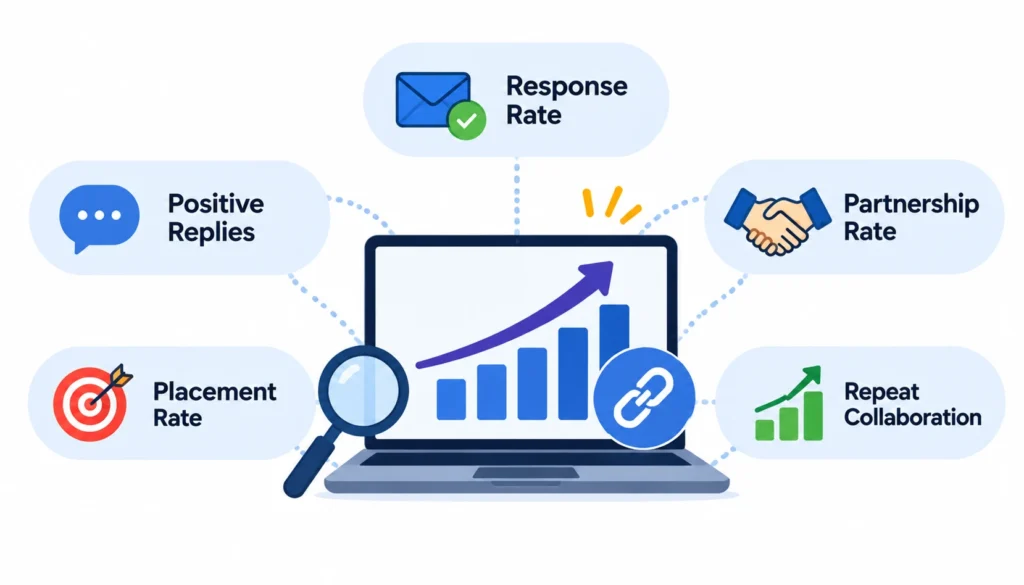
You cannot improve what you do not track. These five metrics give you a clear picture:
| Metric | What it measures | How to calculate |
| Response rate | How many people reply at all | Replies ÷ emails sent |
| Positive reply rate | How many replies show interest | Positive replies ÷ total replies |
| Partnership acceptance rate | How many conversations turn into agreements | Agreements ÷ positive replies |
| Successful placement rate | How many agreements produce a live link | Live links ÷ agreements |
| Repeat collaboration rate | How many partners work with you again | Repeat partners ÷ total partners |
Review them monthly. If your response rate is low, look at your targeting and subject lines. If your acceptance rate is low, look at your offer and negotiation approach.
Benchmarks vary widely by niche and quality, so compare yourself with your own past results first.
A Real-World Example: From Cold Email to Long-Term Partner
Here is how a typical relationship develops. The names are fictional, but the pattern is common.
- Week 1. You comment on a blogger’s LinkedIn post about email deliverability. You send a short connection note.
- Week 2. You email her a brief idea for a guest article. She replies that she accepts only paid posts.
- Week 2. You ask politely about rates and labeling. Your budget does not fit, so you offer an expert quote for an upcoming roundup instead.
- Week 3. She accepts the quote. You send it on time and thank her.
- Week 8. She shares the published roundup. You share it with your audience and send her a data point for a future article.
- Month 6. She invites you to contribute a guest post, free of charge, because she trusts you.
No single message did the work. The relationship did.
Frequently Asked Questions
How Do You Communicate With Link-Building Partners?
Be clear, polite, and specific. Use the channel they prefer, confirm terms in writing, reply promptly, and keep in touch even when you do not need a link.
What Is the Best Way to Approach Someone for a Backlink?
Lead with value. Mention something specific about their site, explain why your page helps their readers, and make one simple request. Do not ask for a link in the very first line.
How Do You Write a Professional Link-Building Email?
Keep it short. Use a personal greeting, a one-line introduction, a specific suggestion, a clear benefit for their audience, and one call to action. Proofread before sending.
How Many Follow-Up Emails Should You Send?
Two follow-ups after the first email is a good rule. Space them about a week apart, add something useful each time, and then stop.
How Do You Negotiate a Link Exchange?
Keep it relevant and low-pressure. Make sure each page genuinely helps the other site’s readers. Remember that Google’s spam policies warn against excessive link exchanges, so avoid large-scale swapping.
How Do You Maintain Long-Term Relationships With Link-Building Contacts?
Stay in touch between projects, share useful opportunities, say thank you, and keep a simple record of your conversations. Consistency matters more than frequency.
What Should You Do When a Link-Building Contact Stops Responding?
Follow up twice, a week apart. If there is still no reply, pause, and reconnect months later with something new. For active paid work, keep records and decide whether to replace the partner.
Which Tools Help Manage Link-Building Communication?
Gmail or Outlook for email, Hunter.io and LinkedIn for finding contacts, BuzzStream, Pitchbox, or HubSpot CRM for managing relationships, and Google Sheets with Google Calendar for simple tracking.
Conclusion
Knowing how to communicate effectively with link building contacts is a skill you can practice. It comes down to a few habits: do your research, lead with value, be honest about terms, accept “no” gracefully, and keep in touch after the link goes live.
Treat each contact as a future partner, not a one-time target. The links will follow the trust. If you want one place to start, pick three past contacts this week and send each a short, useful, no-strings message.