

Most link building starts the same way. You send 100 cold emails, get a handful of replies, and start over next month.
It works for a while. Then it gets messy. You forget who replied, who said “maybe later,” and who you already pitched twice.
A better approach is building and managing a link building network. Instead of chasing strangers, you build a small group of relevant people who know you and trust your work.
This guide shows you how to do that from scratch. You’ll learn how to find partners, organize them, handle link exchanges safely, and grow without losing quality.
What Is a Link Building Network?
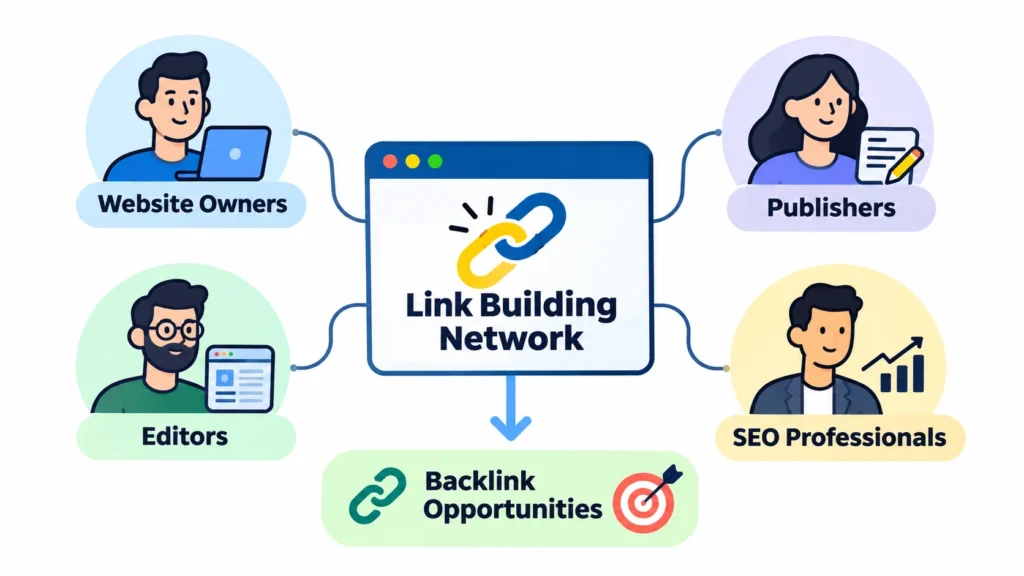
A link building network is a group of website owners, publishers, editors, and SEO professionals who keep professional relationships to find and coordinate legitimate backlink opportunities.
A well-run network uses a partner database, quality checks, and regular communication. The goal is steady, relevant links earned through real collaboration.
Think of it like a contact list for your SEO work. Each person on it is someone you can reach out to with a useful idea, and who may do the same for you.
1. How Does a Link Building Network Work?
The cycle is simple:
- You find relevant people in your industry.
- You build a real relationship by offering value.
- You track each partner, their niche, and past conversations.
- When an opportunity fits, such as a guest post, a resource mention, or a content collaboration, you already know who to talk to.
- You review results and keep the partners who work out.
2. Link Building Network vs. Traditional Link Building
Traditional outreach is transactional. You pitch a stranger, ask for a link, and move on.
A network is relational. You talk to the same people over time, so each new pitch starts with some trust.
| Traditional Outreach | Link Building Network | |
| Contact type | Mostly cold | Mostly warm over time |
| Effort per link | Usually high | Drops as relationships grow |
| Tracking | Often scattered | Centralized database |
| Link relevance | Varies | Easier to keep consistent |
3. Types of Link Building Networks
Networks come in a few forms. Most people mix several:
- Website owner networks: independent site owners in related niches.
- SEO professional communities: people who share tips and sometimes opportunities.
- Publisher and blogger partnerships: editors who accept contributions.
- Niche groups: communities built around one industry, like SaaS or finance.
- Editorial content partnerships: ongoing collaborations like co-created studies or expert roundups.
4. Link Building Network vs. Private Blog Network (PBN)
These are not the same thing, and mixing them up can hurt you.
A link building network is made of independent people and sites that you build relationships with. A private blog network is a set of sites you control and create mainly to pass links to your own site. Google treats that as a link scheme. For a broader view of low-value linking setups, see this overview of link farms.
If a site exists mainly to link out for ranking, it does not belong in your network.
Why Should You Build a Link Building Network?
A network won’t replace good content. But it makes your outreach more efficient and more consistent.
You build long-term relationships. People reply faster to someone they already know. One good partner can lead to many opportunities over the years.
You find more relevant opportunities. Your partners often hear about openings before they are public. They also tend to know your niche well.
You cut repetitive work. You stop researching and pitching from zero every time. Your database does the remembering.
You stay organized. Every contact, conversation, and link lives in one place.
You grow your visibility. Partners mention you, share your work, and recommend you, which helps beyond SEO.
How to Build a Link Building Network from Scratch
Here is a six-step process. You can start today with nothing but a spreadsheet and an inbox.
Step 1: Identify Your Target Niches
Start with your own site. What is your main topic? Then list two or three closely related topics your audience also cares about.
For example, a project management software company might target:
- Productivity and remote work
- SaaS and startup blogs
- Small business and entrepreneurship
Write these down as categories. You’ll use them to sort partners later.
Step 2: Find Potential Link Building Partners
Don’t try every method. Pick three or four and do them well.
Search Google for relevant websites. Search your topic plus phrases like “write for us,” “resources,” or “contributors.” Look beyond page one.
Analyze competitor backlink profiles. Use a tool like Ahrefs or Semrush to see who links to your competitors. Sites that link to several competitors often accept outside input.
Use LinkedIn to find SEO professionals. Search for content managers, editors, and SEO leads in your niche. LinkedIn also has groups focused on SEO and content marketing.
Join SEO communities. Active forums like SEO and bigseo on Reddit let you learn and answer questions. Read the rules first, because many communities ban link drops and promotion.
Explore guest posting. Writing a good guest post gives you a direct line to an editor. If it goes well, you can work together again.
Contact website owners and publishers directly. Many small site owners are open to ideas if you’re polite and specific.
Step 3: Evaluate Potential Partners
Not every site deserves a spot. Before you reach out, check these:
- Topical relevance: Does the site cover subjects close to yours? This matters most.
- Organic traffic: Does it get real search traffic? A tool can show trends. Be cautious of sudden spikes that look unnatural.
- Domain Rating or Domain Authority: These are third-party scores from Ahrefs and Moz. Google does not use them. Treat them as rough hints only.
- Backlink profile: Look at referring domains. Many spammy or off-topic links are a red flag.
- Content quality and frequency: Is it updated? Is it written for people?
- Suspicious patterns: Watch for sites that sell links openly, publish on every topic, or are packed with ads.
A site with a modest score and a real audience beats a high-score site with no readers.
Step 4: Find the Right Contact Person
A great site is useless if your email goes to the wrong inbox. Aim for:
- Website owners (best for small sites)
- Editors and content managers
- SEO or digital marketing managers
Check the “About” or “Team” page and LinkedIn. A tool like Hunter can help you find professional email addresses. Always confirm the person actually works there.
Step 5: Reach Out and Build the Relationship
Keep your first message short. Say who you are, why you’re writing to them in particular, and what you can offer.
A simple structure:
- A specific compliment about their work.
- One clear idea that helps their audience.
- A low-pressure next step.
Here is a realistic example:
Hi Maria, I read your guide on remote team onboarding. Your checklist section was really practical. I run content at a project management tool and just finished a short survey of 200 remote managers on onboarding gaps. Happy to share the data if it would be useful for a future update. No strings attached.
Notice what’s missing. There’s no link request. You lead with value.
If you don’t hear back, follow up once after about a week. If there’s still no reply, move on and note it in your database.
Step 6: Start With a Small Group of Reliable Partners
Don’t aim for 200 contacts. Start with five.
Hunter’s link building outreach guide makes a similar point: begin with a few strong relationships, then grow. That fits what I see in practice. Five partners who reply within a day are worth more than 50 who never write back.
Work closely with these five. Learn what each one needs. Then expand based on what actually works.
How to Find and Connect with Link Building Partners
Step 2 gave you the methods. Here are tips for making the connections last.
Be useful first. Share a partner’s article, send them a stat they might like, or answer their question in a community. Small gestures add up.
Show up regularly. Comment on their posts on LinkedIn. Reply to their newsletters. People remember familiar names.
Go where your niche gathers. That might be industry blogs, webinars, conferences, or small Slack and Discord groups. If you’re setting up your tracking system, this guide to creating a backlink tracking spreadsheet explains which fields to include and how to organize backlink records efficiently.
Use your existing contacts. Past colleagues, clients, and customers often run or know relevant sites. Ask for introductions.
Consider starting your own community. A small newsletter, roundup, or private group can pull people toward you. This takes time, so treat it as a later step.
How to Organize and Manage Your Link Building Network
This is where most networks fail. People collect contacts but never organize them.
You do not need expensive software at the start. A well-built Google Sheet is enough for your first 30 to 50 partners. If you’re setting up your tracking system, this guide to creating a backlink tracking spreadsheet explains which fields to include and how to organize backlink records efficiently.
Create a Centralized Partner Database
Track these fields for every partner:
| Field | Why It Matters |
| Website URL | Your reference point |
| Niche | Helps you match opportunities |
| Contact name and email | Who to reach |
| Domain Rating / Authority | Rough quality signal |
| Estimated organic traffic | Checks real audience |
| Collaboration type | Guest post, resource mention, etc. |
| Partnership status | Prospect, active, paused, removed |
| Last contact date | Prevents ghosting and double pitches |
| Notes | Preferences, past topics, things they dislike |
Categorize Partners by Niche
Sort your partners into groups. For a marketing-focused business, categories might be:
- SaaS and technology
- Digital marketing
- Finance and accounting
- Education
- E-commerce
When a new piece of content is ready, you can scan one category and see who might care.
Track Link Opportunities
Add a second tab for opportunities. Log each one with its type, partner, date, status, and the live URL once it goes up.
Common types to track:
- Guest post opportunities
- Link insertions into existing articles
- Resource page mentions
- Editorial mentions and quotes
Keep a Communication History
Write short notes after every conversation. “Asked for data on pricing trends. Follow up in March.”
This tiny habit makes you look organized and attentive. It also saves you from repeating pitches.
Assign Relationship Owners
If you work in a team, give each partner one owner. Two people emailing the same editor creates confusion fast.
Monitor Active and Inactive Partners
Mark partners who haven’t replied in three or more months as inactive. Don’t delete them right away. Try a friendly check-in first.
Update Metrics and Remove Weak Partners
Review your database every quarter. Update traffic and relevance. Remove sites that lost traffic, changed focus, or started selling links openly.
A Practical Example
Imagine you manage 30 partners across SaaS, finance, marketing, and education.
You tag each partner by niche and status. Next week you publish a study on remote work trends. You filter for “SaaS” and “marketing,” status “active,” and see nine partners. You then check notes to find three who liked data-driven content before.
You pitch those three, personally. That takes an hour, not a day, and the replies come faster because they already know you.
How to Manage Link Exchanges Within Your Network
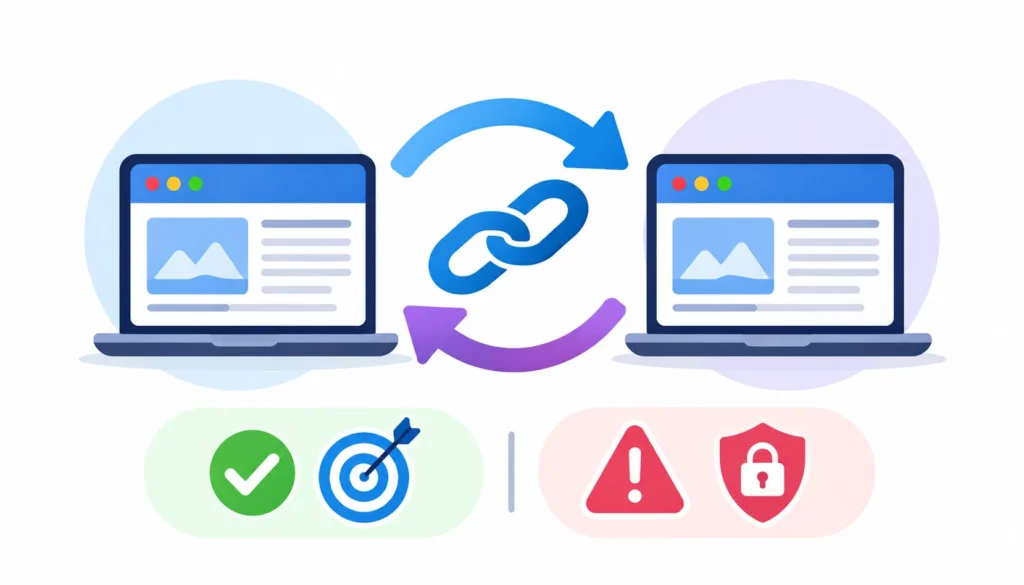
Link exchanges come up often in network conversations. They are also the riskiest part, so handle them carefully.
1. What Is a Reciprocal Link Exchange?
A reciprocal link exchange is when two sites agree to link to each other. “You link to me, I link to you.”
2. What Is a Direct Link Exchange?
This is the same idea, done directly between two sites. Site A links to Site B, and Site B links to Site A, often as part of one agreement.
3. What Is a Three-Way Link Exchange?
In a three-way exchange, Site A links to Site B, Site B links to Site C, and Site C links to Site A. People use it to make the pattern look less obvious.
Be clear on this: a three-way exchange does not make a manipulative arrangement safe. Google looks at purpose and patterns, not just the shape.
4. What Google Says
Google’s spam policies list excessive link exchanges as link spam. Links created mainly to manipulate rankings can lead to lower rankings or manual actions.
Occasional mutual links happen naturally. Two relevant sites often reference each other’s good content. The trouble starts when exchanges become the main way you get links.
5. How to Keep Exchanges Safe
- Link only when the content truly helps readers.
- Make sure both sites are closely relevant.
- Keep anchor text natural, not keyword-stuffed.
- Avoid repeated cross-linking between the same sites.
- Never swap links with link farms or sites you wouldn’t recommend to a friend.
- Use rel=”sponsored” for paid or compensated placements, as Google explains in its guide to qualifying outbound links. You can read more about the nofollow attribute too.
6. Common Link Exchange Mistakes
- Doing too many reciprocal links.
- Working with irrelevant sites.
- Using the same exact-match anchor text each time.
- Choosing partners by Domain Rating alone.
- Forgetting to log who linked to whom.
A good rule: if the link would make sense even without the return favor, it’s probably fine.
Best Tools for Building and Managing a Link Building Network
You don’t need all of these. Pick what fits your size and budget.
| Tool | Main Use | Best For |
| Google Sheets | Partner database | Starting out |
| Ahrefs | Backlink analysis | Finding partners via competitors |
| Semrush | SEO research and audits | Competitor and gap analysis |
| Hunter | Finding email addresses | Contact discovery |
| BuzzStream | Relationship and outreach management | Teams managing many contacts |
| Pitchbox | Outreach automation | Scaling campaigns |
| Respona | Prospecting and outreach | Combined research and outreach |
| Professional networking | Finding people and warming up contacts | |
| Google Search Console | Search performance | Checking whether links help |
How to Choose
Ask three questions:
- How many partners do I manage today? Under 50, a spreadsheet may be enough.
- How many people work on this? More people means you need shared tracking.
- Where is my time going? If it’s email follow-ups, an outreach tool will help.
Don’t buy software to fix a process you haven’t built yet.
How to Scale Your Link Building Network
Once your first five partners work well, you can grow. Here’s an illustrative path. These numbers are examples, not rules.
| Stage | Active Partners | Main Focus |
| Initial | About 5 | Building trust |
| Growing | 10–20 | Expanding opportunities |
| Established | 20–50 | Maintaining relationships |
| Advanced | 50+ | Managing several niches |
Hunter’s guide mentions working with around 20 to 50 active relationships as a realistic range for many people. Your own limit depends on your time and team.
Ways to Scale Without Losing Quality
Expand into related niches. Add partners one topic away from your core, not ten.
Create partner groups. Group by niche so each group gets tailored ideas.
Document your process. Write down how you evaluate partners and what a good pitch looks like. This lets others join without lowering standards.
Automate admin, not relationships. Reminders and tracking can be automated. Personal messages should stay personal.
Say no sometimes. Turning down a poor-fit partner protects your network.
How to Measure Link Building Network Performance
If you don’t measure, you can’t tell what’s working. Track these every month or quarter. Effective backlink management also involves monitoring link status, evaluating link quality, and identifying backlinks that have disappeared or changed.
- Active partners: How many replied or collaborated recently?
- Response rate: How many of your outreach emails get replies?
- Placement rate: How many conversations end in a live link?
- Referring domains: How many relevant, unique sites link to you?
- Link quality and relevance: Are links on topic and editorial?
- Referral traffic: Do the links send real visitors? You can check this in Google Analytics.
- Organic performance: Are rankings and impressions improving in Google Search Console?
- Partner retention: How many partners are still active after six or twelve months?
Build a simple dashboard in a spreadsheet with one row per month. Over time, you’ll see which partners and which niches deliver the most.
One caution: links alone rarely move rankings. Content quality, site health, and search intent still matter.
Common Link Building Network Management Mistakes
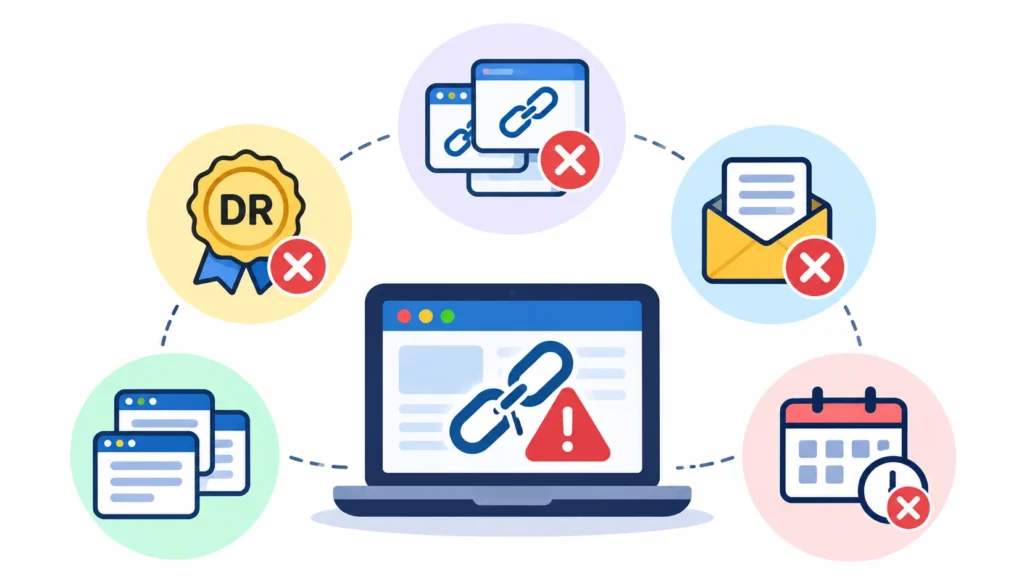
Chasing Domain Rating over relevance. A relevant mid-size site usually helps more than a famous, off-topic one.
Building a huge but dead database. A list of 500 unresponsive contacts is clutter.
Ignoring site quality. One bad partner can pull your profile in the wrong direction.
Sending generic emails. People can spot templates instantly.
Forgetting past exchanges. Without tracking, you may repeat links and create obvious patterns.
Overusing reciprocal links. See the section above.
Ignoring Google’s guidelines. Read them. They’re short and clear.
Neglecting relationships. If you only write when you need something, partners fade away.
Best Practices for a Sustainable Link Building Network
- Quality over size. Five great partners beat fifty weak ones.
- Stay relevant. Topic fit is your best filter.
- Communicate regularly. A quick check-in every few months is enough.
- Give before you ask. Share data, quotes, or feedback first.
- Audit your database every quarter. Remove dead weight.
- Diversify. Mix guest posts, digital PR, resource mentions, and content partnerships. Don’t rely on one tactic.
- Follow Google’s Search Essentials. When unsure, choose what helps readers.
Frequently Asked Questions
What is a link building network?
A link building network is a group of relevant website owners, publishers, and SEO professionals who maintain professional relationships to find and coordinate legitimate backlink opportunities. It relies on structured outreach, a partner database, and quality checks.
How do you build a link building network from scratch?
Follow these steps:
- Pick your target niches.
- Find relevant sites and contacts.
- Evaluate each site for relevance and quality.
- Find the right contact person.
- Send a personal, value-first message.
- Start with about five reliable partners, then grow.
How many link building partners should you have?
There’s no fixed number. Many people start with around five and grow to 20–50 active relationships as they gain time and process. Quality and responsiveness matter more than count.
How do you find website owners for link building?
Search Google for relevant blogs, review competitor backlinks, check About pages, use LinkedIn, and join communities like r/SEO. Confirm the person actually runs or works on the site before writing.
What is the best way to manage link building partners?
Use one central database that tracks niche, contact, status, last contact date, and notes. Review it each quarter. A spreadsheet works well at first.
Are link exchanges safe for SEO?
Occasional, natural mutual links are usually fine. Excessive or manipulative exchanges are listed as link spam in Google’s policies. Keep exchanges relevant, limited, and editorial.
What tools help manage link building networks?
Google Sheets for tracking, Ahrefs or Semrush for research, Hunter for contact discovery, and BuzzStream, Pitchbox, or Respona for outreach management.
How do you track link building partnerships?
Log each opportunity with partner name, type, date, status, and live URL. Add notes after each conversation and update status regularly.
How can you scale a link building network?
Expand to related niches, group partners by topic, document your process, automate admin tasks, and keep quality checks in place as the list grows.
What is the difference between a link building network and a PBN?
A link building network is made of independent partners you collaborate with. A PBN is a set of sites you control mainly to pass links to your own, which Google treats as a link scheme.
Conclusion
Building and managing a link building network is less about tricks and more about habits. Find relevant people, be useful, write things down, and keep your standards high.
A tidy partner database, honest outreach, and careful handling of link exchanges will take you further than any bulk campaign. Over time, each good relationship makes the next opportunity easier to land.
Start small. Pick five relevant partners this month, set up your spreadsheet, and send your first value-first message today. Then grow one careful step at a time.