
A link building network is a group of website owners, publishers, bloggers, SEO professionals, and agencies who connect to find backlink opportunities and collaborate on content. Members share relevant publishing partners, organize outreach, and earn links while following search engine guidelines.
That is the short answer. The longer answer matters more, because the phrase “link building network” means different things to different people. Some mean a healthy community of real publishers. Others mean a private blog network (PBN) built to push rankings. Those two are not the same thing, and mixing them up can cost you traffic.
In this guide, I’ll explain what a link building network is, how it works, and which types exist. I’ll also show you how to evaluate members, manage partners, and avoid the risks that get sites in trouble. No ranking promises here. Just a clear, practical walkthrough.
What Is a Link Building Network?
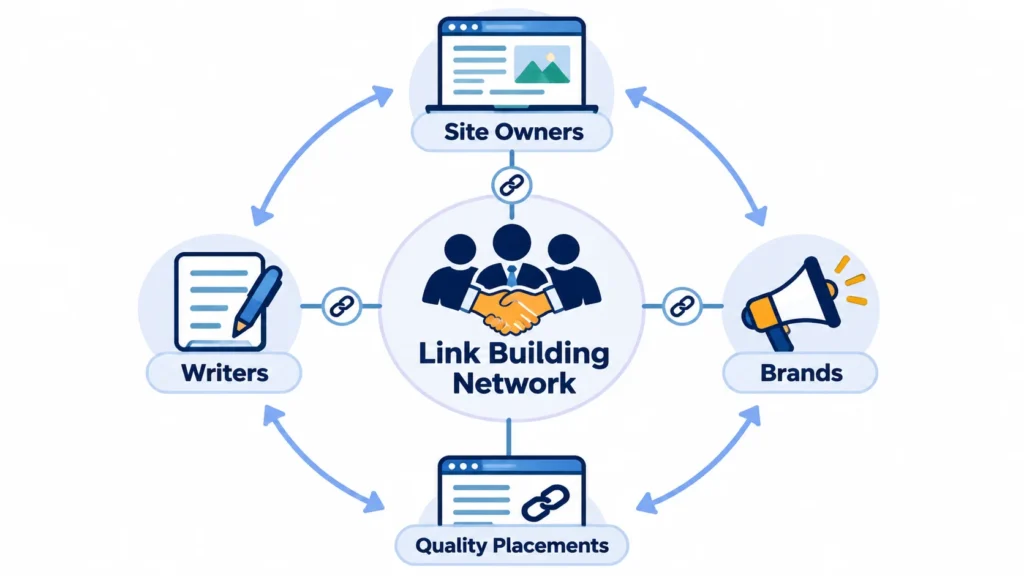
Think of it as a professional circle built around backlinks. Everyone in the circle either owns a site, writes for sites, or helps brands get featured on sites. They talk to each other, trade opportunities, and work out placements that make sense for readers.
A backlink, as Wikipedia explains, is simply a link from one web page to another. Search engines have used links as a signal since the early days of PageRank. Link building is the work of earning those links. A network just makes that work faster and more organized.
Understanding the Concept
A network does three things well:
- It connects people who would never find each other through cold outreach alone.
- It builds trust, so conversations start warm instead of cold.
- It gives structure to a messy job: tracking sites, contacts, and placements.
A network does not create rankings. It creates access and organization. What you do with that access decides the outcome.
Who Participates in a Link Building Network?
Most networks include a mix of these roles:
- Website owners and webmasters. They run the sites that publish content and give links.
- Bloggers and content publishers. They look for good contributors and useful resources to cite.
- SEO professionals and link builders. They find placements for their own sites or clients.
- Digital marketing agencies. They manage many clients and need a reliable pool of publishers.
- Guest posting and outreach specialists. They handle the emails, pitches, and follow-ups.
Why Do Link Building Networks Exist?
Link building is slow when you work alone. You research sites, hunt for emails, pitch, wait, and follow up. Most pitches go unanswered.
A network shortens that path. Members already know each other’s niches and standards. That helps with finding partners, organizing outreach, and scaling campaigns without starting from zero every time.
How Does a Link Building Network Work?
Every network runs a little differently. Still, the working process follows a similar pattern.
- Members join the network. This can be an application, an invitation, or just joining a community.
- Websites are submitted. Members share the sites they own or represent.
- Quality and relevance are checked. Someone reviews content, traffic, and linking habits.
- Members discover partners. They browse or search by niche and topic.
- Collaboration is discussed. Guest posts, resource mentions, and expert quotes are common.
- Content and links are placed. The agreed content goes live.
- Results are monitored. Members check that links stay live and bring value.
Here is each step in plain terms.
Step 1: Finding and Connecting With Members
Networks form in many places: private Slack or Discord groups, LinkedIn communities, industry forums, and agency partner lists. Public communities like SEO and big seo on Reddit also act as informal hubs where practitioners swap lessons and warn each other about bad actors.
Step 2: Submitting and Verifying Websites
Good networks ask for proof that a site is real. That could mean checking the domain, reviewing the content archive, and confirming the person actually controls the site. Skipping this step is how networks fill up with junk.
Step 3: Evaluating Quality and Relevance
A site should fit its topic, publish useful content, and have real readers. I cover a full checklist below.
Step 4: Discovering Opportunities
Opportunities include guest post slots, “write for us” pages, resource lists, expert roundups, and data or study mentions.
Step 5: Setting Collaboration Terms
Agree on the basics before any work begins. Who writes the content? Who approves it? Which links are allowed? Are any links labeled as sponsored? Clear terms prevent problems later.
Step 6: Managing Content and Placements
The publisher reviews the content, edits it, and publishes it. Good publishers keep editorial control. That is what keeps a placement a real editorial one.
Step 7: Monitoring Backlinks and Results
Check whether the link is live, indexed, and sending visitors. A free place to start is the Links report in Google Search Console.
Types of Link Building Networks
Not all networks work the same way. Here are the main types.
1. Private Collaboration Networks
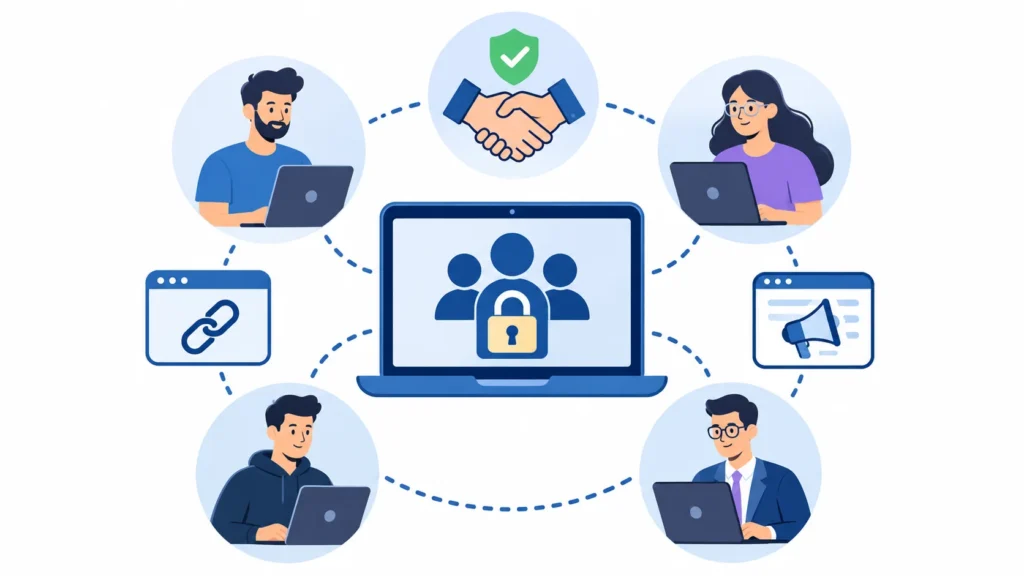
These are closed communities, often invitation-only, where trusted SEOs and site owners share opportunities. Trust is the main currency here.
2. Guest Posting Networks
Publishers list topics they want, and writers pitch articles. When done well, both sides gain: the site gets useful content and the writer gets exposure and a link.
3. Link Exchange Networks
Members agree to link to each other. A few natural, relevant mentions are normal on the web. But Google lists excessive link exchanges as link spam in its spam policies, so this type needs the most caution.
4. Publisher and Blogger Networks
These connect brands with bloggers and editors who review products, share expertise, or cover industry news.
5. SEO Agency Partner Networks
Agencies team up with other agencies, freelancers, and publishers. This helps them serve clients in niches where they lack contacts.
6. Digital PR and Outreach Networks
Here, brands connect with journalists, editors, and industry publications. The goal is coverage that earns links as a natural result.
7. Private Blog Networks (PBNs)
A private blog network is a group of sites, often controlled by one person, built mainly to pass links to a target site. This is the risky one, and the next section explains why.
Link Building Network vs. Private Blog Network (PBN)
This is where most confusion happens. Both involve “a network” and both involve links. The intent and structure are very different.
What Is a Legitimate Link Building Network?
It is a community of independent people who collaborate. Each site has its own owner, audience, and editorial standards. Links appear because the content deserves them.
What Is a Private Blog Network?
A PBN is usually a set of sites owned or controlled by one operator. The sites often exist to link out to money sites. Ownership may be hidden. Content is often thin and written to carry links.
Key Differences
| Factor | Legitimate Link Building Network | Private Blog Network |
| Purpose | Connects relevant owners and publishers | Uses linked sites to influence rankings |
| Ownership | Independent website owners | Often controlled by one operator |
| Content | Independent editorial content | Often created mainly to carry links |
| Relationships | Real collaboration and partnerships | Controlled linking structure |
| Transparency | Participants are known | Ownership may be hidden |
| Risk | Depends on actual linking practices | High when used to manipulate rankings |
One important point: a legitimate network is not automatically safe. If members trade paid links that pass ranking credit, or swap links at scale, the network can still break Google’s rules. What members actually do matters more than what the group calls itself.
Why You Should Avoid Manipulative Link Networks
Google’s spam policies describe link spam as links meant to manipulate rankings. Examples include buying or selling links that pass ranking credit, excessive link exchanges, and automated link creation. Sites caught doing this can lose visibility through automated systems or manual actions.
The practical takeaway is simple. If a link would not exist without a deal made purely for SEO, treat it with care.
Why Are Link Building Networks Important for SEO?
Backlinks remain a core part of off-page SEO. A network can make earning them more efficient. It will not guarantee higher rankings, and anyone who promises that is selling something.
1. Access to Relevant Opportunities
Members already work in your space. That means fewer random pitches and more topical matches.
2. Relationships With Site Owners
A warm introduction beats a cold email. Over time, repeat partners may invite you back without a pitch.
3. Guest Posting Opportunities
Networks often know which sites accept contributors and what editors want.
4. Better Outreach Efficiency
When you know which sites fit, you send fewer emails and get better replies.
5. Brand Visibility and Referral Traffic
A good placement sends real visitors. Referral traffic is often a better quality check than any authority score.
6. Scaling Campaigns
Agencies can handle more clients when they have a reliable partner pool and a clean tracking system.
How to Build a Reliable Link Building Network
Here is a practical process you can start this month.
Step 1: Pick Your Niche
Be specific. “Marketing” is too broad. “Email marketing for ecommerce brands” is better. A tight niche makes it easier to judge relevance.
Step 2: Find Relevant Site Owners and Publishers
Look in places where your niche already talks:
- Industry blogs and newsletters
- Conference speaker and sponsor lists
- LinkedIn groups and creators in your field
- Reddit communities such as r/SEO and r/bigseo
- Authors who already write for sites you respect
Step 3: Evaluate Potential Members
Use the checklist in the next section before you add anyone.
Step 4: Create a Partner Database
A simple spreadsheet works at first. Track the site, contact, niche, quality notes, and past work. Move to a CRM or outreach tool when volume grows.
Step 5: Set Clear Guidelines
Write short rules. Require relevance. Ban hidden paid links. Require proper link attributes where money is involved. Agree on content quality standards.
Step 6: Build Long-Term Relationships
Help first. Share their content, send useful tips, and introduce them to others. People remember who gave before asking.
Step 7: Review Quality Regularly
Sites change hands, traffic drops, and quality slips. Review your list every quarter and remove partners who no longer meet your standards.
A Realistic Scenario
Say a small SaaS agency works with three site owners: one runs a technology blog, one a digital marketing site, and one a SaaS publication. They share what topics they want to cover and what they refuse to publish.
When a client needs coverage on cloud security, the agency checks which site fits best. It reviews each candidate’s audience, content quality, and outbound links. It then pitches only the best match, with a useful article instead of a link request.
Notice what is missing: no mass emails, no guaranteed links, and no pressure. That is what a healthy network looks like in practice.
Creating a sustainable network requires more than finding website owners. Understanding the process of building and managing a link building network helps you organize partnerships, track opportunities, maintain relationships, and scale your link building efforts effectively.
How to Evaluate Websites Before Accepting a Backlink
Ask these questions before you agree to any placement. Conducting a regular backlink profile audit also helps identify suspicious linking patterns, irrelevant referring domains, and potentially harmful backlinks before they affect your SEO efforts.
1. Domain Authority and Domain Rating
Moz’s Domain Authority and Ahrefs’ Domain Rating are third-party scores. They estimate link strength and are useful for comparing sites. They are not Google ranking factors, so do not treat them as proof of quality.
2. Organic Traffic and Visibility
Does the site get search traffic? Is it stable or falling sharply? A site with a decent score but no real visitors is a red flag.
3. Topical Relevance and Audience Fit
Would your target reader plausibly read this site? If not, the link is unlikely to help anyone.
4. Referring Domains and Backlink Quality
Look at who links to the site. A natural mix of sources is healthy. A profile full of odd, unrelated links is not.
5. Anchor Text Patterns
Natural anchors are varied: brand names, page titles, plain URLs, and descriptive phrases. Repeated exact-match commercial anchors look forced.
6. Content Quality and Editorial Standards
Read a few posts. Are they useful, original, and edited? Or do they read like filler written around links?
7. Outbound Link Patterns
Check where the site links out. If every article links to casino, loan, or pill sites, walk away.
8. Site History and Trust
Look at the archive. Has the site changed topics overnight? Did it appear to be an expired domain repurposed for links? Those are warning signs.
9. Quick Checklist
- Is the site indexed and active?
- Is the content original and useful?
- Does the topic match yours?
- Does it get real traffic?
- Are outbound links clean?
- Is the owner real and reachable?
Link Attributes You Should Know
Google asks site owners to label certain links. Google’s guidance on qualifying outbound links covers three attributes:
- rel=”sponsored” for paid or sponsored placements
- rel=”ugc” for user-generated content such as comments and forum posts
- rel=”nofollow” for links you do not want to vouch for
Using these correctly protects both sides. It also keeps a network honest. Sponsored content can still bring visitors and brand awareness, even when it does not pass ranking credit.
Best Tools for Managing a Link Building Network
You do not need all of these. Start with what fits your size.
| Tool | Primary Purpose | Best For |
| Ahrefs | Backlink analysis and competitor research | Evaluating sites and finding link gaps |
| Semrush | Backlink audits and competitor analysis | All-in-one SEO teams |
| Moz | Link analysis and domain metrics | Quick authority checks |
| Google Search Console | Search performance and link reporting | Monitoring your own site for free |
| Hunter | Finding professional email addresses | Outreach prospecting |
| BuzzStream | Outreach and relationship tracking | Managing many contacts |
| Pitchbox | Outreach campaign management | Agencies running campaigns |
| Respona | Prospecting and outreach | Teams combining research and email |
For small networks, a spreadsheet and a shared inbox can carry you a long way. Tools help most once you manage dozens of partners.
Link Building Network Management: Best Practices
Good management keeps a network healthy as it grows. Effective backlink management helps SEO professionals organize their link inventory, monitor placements, identify lost links, and maintain a healthy backlink profile as their network grows.
- Keep an updated inventory. List every site, its owner, and its status.
- Categorize by niche. This makes matching fast.
- Track quality over time. Note traffic, content standards, and any warning signs.
- Keep contacts current. People change roles. Old emails bounce.
- Monitor placements. Confirm links stay live and are tagged correctly.
- Document agreements. Even a short email thread saves arguments later.
- Audit existing backlinks. Catch spammy or broken links early.
- Remove weak members. A smaller, clean network beats a large, risky one.
Common Risks and Mistakes
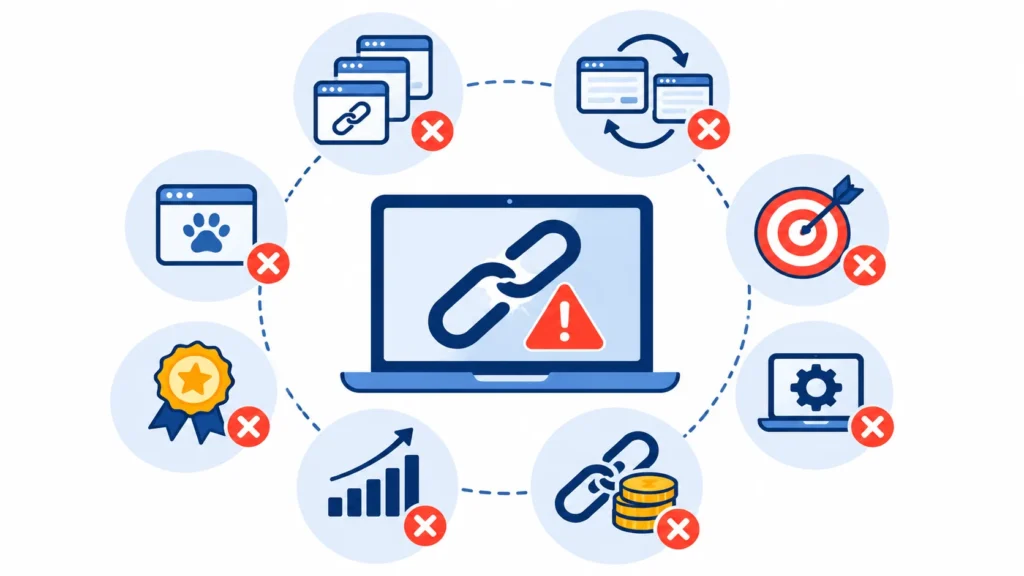
Most problems in link building networks come from shortcuts, poor-quality partnerships, and attempts to manipulate search rankings. While building relationships with website owners can create valuable backlink opportunities, not every network or placement is worth pursuing. Watch out for these common mistakes.
- Joining link farms. Link farms are groups of websites or pages created primarily to exchange or distribute backlinks rather than provide useful content. Links from these sources rarely offer meaningful value to readers and can expose your website to search engine spam risks. Always check whether a website publishes genuine, relevant content before accepting a link.
- Excessive reciprocal links. Occasional link exchanges between relevant websites can happen naturally. However, repeatedly following a “you link to me, I link to you” arrangement across multiple websites can create an unnatural linking pattern. Focus on genuine editorial relationships instead of making backlinks a condition of every collaboration.
- Working with irrelevant websites. Topical relevance matters when evaluating backlink opportunities. For example, a pet care blog linking to a payroll management tool offers little contextual value to its readers. Prioritize websites that cover related industries, topics, or audiences so that backlinks make sense within the surrounding content.
- Overusing exact-match anchor text. Using the same keyword-rich anchor text repeatedly can make your backlink profile appear unnatural. Instead of forcing exact-match keywords into every placement, use natural variations, branded terms, descriptive phrases, and relevant contextual anchors that fit the content.
- Ignoring website quality. A high number of backlinks does not automatically indicate a strong website. Some sites may have inflated authority metrics, declining organic traffic, thin content, or suspicious outbound linking patterns. Before collaborating, review the website’s content quality, organic visibility, backlink profile, and audience relevance.
- Buying links that pass ranking credit. Paying website owners for backlinks that pass ranking credit without appropriate link qualification can violate Google’s spam policies. If a placement is sponsored or paid, use the appropriate rel=”sponsored” attribute, or rel=”nofollow” where applicable, to identify the commercial relationship.
- Using automation to create links. Automated tools can help organize prospecting and outreach, but using software to generate backlinks through automated link exchanges, mass submissions, or manipulative placements can create serious SEO risks. Use automation to improve workflow efficiency, not to manufacture unnatural links.
- Chasing quantity instead of quality. Acquiring hundreds of backlinks from weak or unrelated websites is unlikely to provide the same value as earning relevant editorial links from trustworthy publications. Evaluate each opportunity based on relevance, content quality, audience value, and editorial standards rather than focusing only on backlink numbers.
To keep your link building network safe, follow Google’s Spam Policies for Google Web Search. Before accepting any backlink opportunity, ask yourself one important question: Would this link still exist if search engines did not use backlinks as a ranking signal? If the answer is no, reconsider the placement.
How to Measure Network Success
Track a handful of metrics. Do not drown in numbers.
- Verified members: how many vetted sites you have
- Active partners: how many actually publish with you
- Referring domains earned: new, relevant sites linking to you
- Backlink quality: relevance and editorial context
- Outreach response rate: replies divided by emails sent
- Placement success rate: pitches that became live links
- Referral traffic: visitors arriving through those links
- Cost per placement: total spend divided by live placements
- Link retention rate: links still live after several months
Compare results over time, not week to week. Link building results move slowly.
Link Building Network vs. Link Building Agency
| Factor | Link Building Network | Link Building Agency |
| Business model | Community or partner pool | Paid service |
| Responsibility | You do much of the work | The agency does the work |
| Site access | Direct relationships | Agency’s own contacts |
| Pricing | Often time, trade, or membership cost | Retainer or per-project fees |
| Control | High | Shared |
| Scalability | Grows with your effort | Grows with your budget |
When Should You Join a Network?
Join when you have time, want direct relationships, and are comfortable vetting sites yourself.
When Should You Hire an Agency?
Hire one when you lack time or experience, or need steady output. Ask any agency how it finds sites and what it does about link labeling. Vague answers are a warning.
The Future of Link Building Networks
Expect more tools for prospecting and outreach, including AI-assisted ones. Data-driven site evaluation will keep improving. Editorial relevance and transparency will matter more as search engines get better at spotting manufactured links.
I will not predict how Google’s ranking systems will change. Nobody outside Google knows. The safer bet is to build relationships and content that would hold value even if links counted for less.
Frequently Asked Questions About Link Building Networks
What is a link building network?
It is a group of website owners, publishers, bloggers, and SEO professionals who collaborate to find backlink opportunities and organize outreach, following search engine guidelines.
How does a link building network work?
Members join, submit and verify their sites, find relevant partners, agree on content and link terms, publish placements, and monitor results.
Are link building networks safe for SEO?
It depends on what members do. Networks built on real editorial collaboration are lower risk. Networks that trade paid links, run link farms, or swap links at scale can violate Google’s spam policies.
What is the difference between a link building network and a PBN?
A legitimate network connects independent site owners. A PBN is usually a set of sites controlled by one operator to pass links to other sites. PBNs carry high risk when used to manipulate rankings.
How can I find link building partners?
Start with niche blogs, industry events, LinkedIn communities, and forums like r/SEO and r/bigseo. Look for sites that publish original work and have a real audience.
Can small businesses benefit from link building networks?
Yes. A small business can get far with a few good local or industry partners. Quality and relevance matter more than size.
What tools are used to manage link building networks?
Common choices include Ahrefs, Semrush, Moz, Hunter, BuzzStream, Pitchbox, and Respona. A spreadsheet works well for small setups.
Final Thoughts
A link building network is, at heart, a group of real people helping each other publish useful things. Done well, it saves time, opens doors, and builds relationships that last longer than any single link.
Quality beats size every time. A small, trusted link building network of relevant publishers will usually serve you better than a huge list of unknown sites. Choose partners carefully, label paid content honestly, and keep your focus on readers.
If you remember one thing, make it this: prioritize relevant websites, genuine relationships, and content that deserves to be read. The links tend to follow.